

Sponsored by


 So, What Actually Happened?
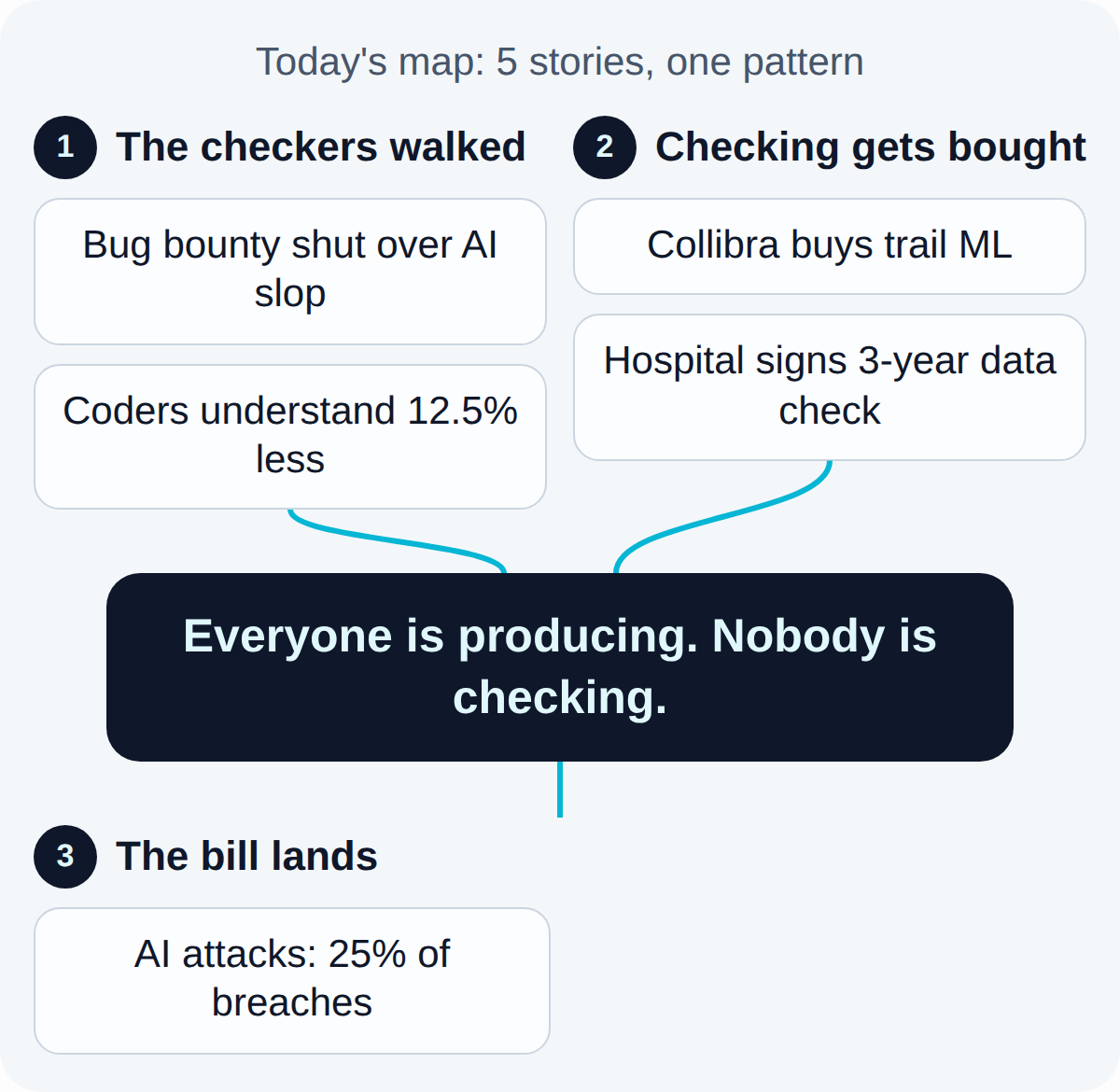
Tuesday, and the thing I keep tripping over is that almost nothing this weekend was about making AI better. It was all about who checks the work. Collibra, a data-governance company, bought a Munich startup called trail ML to turn AI policy into something that actually runs. A chipmaker walked away from its bug bounty programme because the vulnerability reports arriving now are written by machines. We scanned 190,000 articles this week so you don't have to. And a software-engineering study found developers using AI finished more than twice as much work while understanding measurably less of it. Three unrelated industries, one weekend, the same hole in the middle of each.
The Bottom Line: Producing got cheap and checking did not, and almost nobody has repriced that.
 | Yves' take |
The scale of cloud let data chaos explode. Data catalogs brought structure and insight into the data pile. AI and its agents scale any workflow. Plausible answers become decision error at scale. AI governance is the attempt at a rulebook for trustworthy, controllable AI. Will AI build its own governance?
Advertisement
A CRM so smart, it updates itself.

HubSpot's CRM is so smart, it now updates itself. Calls get logged and summarized the moment they end. New leads get researched and a first outreach drafted, automatically. Deals move forward on their own, with next steps flagged before you have to ask.
Even the one repetitive task you've been meaning to fix can now run itself, no code required. Customers using it are already seeing the difference.
This isn't the CRM you have to work hard to figure out. It's the one already working before you log in.
 The Tracks That Matter
1. The Data Catalog Company Bought Its Way Into AI Governance
Collibra spent two decades selling companies a map of their own data. This weekend it picked up trail ML, a Munich outfit whose entire pitch is moving AI governance from policy document to production system. The timing is not subtle. AI governance climbed harder than almost anything else in the conversation this weekend, gaining both volume and its hold on everything around it, while the phrase Collibra built its business on, data governance, pulled plenty of volume and quietly lost grip. That is a vendor reading its own weather forecast. European compliance deadlines are what turn a nice-to-have into a renewal conversation, and Collibra would rather own that module than watch a Munich startup sell it to you directly.
Here's what works: Ask your data-governance vendor what their AI-governance module costs. If the answer is ”included,” get it in writing before the renewal.
2. The Bug Bounty Is Drowning In Machine-Written Reports
For twenty years the deal was simple: find a flaw in my software, I pay you. It worked because writing a credible vulnerability report was hard enough to filter out the noise, and that filter is gone. What lands now is generated, well formatted, plausible and frequently wrong, and the humans triaging it burn their week on fiction. Intel appears to have shut a programme that paid up to $100,000 a bug rather than keep paying people to read it. The attacks, meanwhile, are not fiction: AI-driven intrusions now account for a quarter of global data breaches. The volunteer early-warning network is being jammed in the same quarter the attacks industrialised.
Here's what works: If you run a disclosure programme, fund triage before you fund bounties. An unread report is worth exactly as much as no report.
3. Developers Shipped Twice As Much And Understood Less
A 2026 study in IEEE Transactions on Software Engineering put developers on the same tasks with and without AI help. The assisted group more than doubled median task completeness, and their ability to answer technical questions about the code they had just written dropped 12.5%. Read those two numbers in the wrong order and you have a productivity story. Read them together and you have an ownership problem: the code exists, it runs, and the person whose name sits on the commit cannot defend it in a review. Generation scales, comprehension does not, which is exactly why the real enterprise bottleneck shows up after the demo rather than during it.
Here's what works: Add one question to code review: can the author explain this with the assistant closed? If not, it was accepted, not reviewed.
Quick hits:
- Denmark lost more personal records than it has citizens. The CPR breach exposed 8.8 million records in a country of roughly six million people, which is a useful reminder that national identifier systems fail nationally.
- The cheap model got cheaper. DeepSeek's latest is by far the cheapest well-known model to run, landing the same week Alibaba unveiled Qwen3.8-Max, so your inference budget assumptions from July are already stale.
- Britain's online-safety regulator is now the defendant. Legal challenges to Ofcom under the Online Safety Act are starting to land, and how those go sets the enforcement temperature for every content-moderation obligation you inherit.
Advertisement
Leave Granola and get up to 12 months free of Wispr Flow Notetaker + Dictation

If you have paid time left on an individual Granola plan, we'll match it with a Wispr Flow subscription that includes Notetaker and dictation, and add bonus time, up to 12 months total. Sign in or create a Wispr account and submit proof of your plan to check eligibility.
Your Turn
Which of today's three reads matters most to your work?
One tap. No wrong answers.
 Signal vs. Noise
🟢 Signal: agentic AI. It gained more grip on everything else moving this weekend than any other subject we track, and the buying confirms it. Cohere shipped North 2 with token spending caps, prompt-injection detection and air-gapped deployment. Agents stopped being a demo and became a thing with a budget ceiling and an off switch. Most coverage is still arguing about capability.
🔴 Noise: ”data analytics” as a label. It pulled one of the sharpest jumps in volume all weekend while its hold on the rest of the story slipped backwards. The work did not vanish, it got re-badged. Whoever owns the analytics line in your budget is about to discover it has been renamed and moved.
 From the 190K
We scanned 190,000 articles this week. Here's what no one's talking about:
A Canadian hospital network signed a three-year deal for automated data-quality checking, Litmus shipped a factory-floor data catalog into general availability, and Strike48 put an autonomous security operation into a box you can air-gap. All inside one 24-hour window.
Three separate desks file these and never see each other. Healthcare IT writes up the Waterloo Regional Health Network contract. Industrial automation covers the Litmus catalog launch. The security press runs the Strike48 appliance. Read all three on one morning and they are the same purchase order in three industries: the checking layer for AI is being bought as equipment, with a contract, a renewal date and a vendor you can shout at. Not written as a policy and filed. Buyers have stopped trusting a document to do the verifying and started buying a machine that does it on premises, where they can see it.
On Wednesday, go through your AI controls and separate the ones that are products from the ones that are still PDFs. Then find out what the product version of each PDF costs, because someone is already selling it.
Advertisement
Most teams add a second database for analytics. Then manage sync, lag, and drift forever. TimescaleDB extends Postgres instead. Hypertables, 95% compression, aggregates. No pipeline.
 By The Numbers
- A record 27 companies raised billion-dollar-plus rounds in Q3 2026 — up from 16 in Q2 and 14 in Q1, and those 27 absorbed roughly a third of all global venture capital for the quarter.
- AI startups took $102 billion in Q3, 64% of global venture funding — with half of all capital invested going to companies founded since 2022, per Crunchbase data reported as of October 2.
- Stripe agreed to buy AI model router OpenRouter for $7.5 billion — a payments company paying infrastructure prices for the layer that decides which model answers your request.
- AI-assisted developers answered 12.5% fewer questions about their own code — in a 2026 IEEE Transactions on Software Engineering study where the same group more than doubled median task completeness.
- Overlap between top Google results and AI-cited sources fell from 70% to under 20% — per a 5W report, with Gartner projecting organic search traffic down 50% by 2028. Your SEO rank and your AI visibility are now two different problems.
- See what's rising across AI and data this week →
 Deep Dive: Nobody Buys A Ticket To The Sound Check
Every show has an unglamorous half hour before the doors open. Someone walks the empty room, plays one track, listens to how the back corner sounds, moves a speaker, listens again. No one pays for that half hour. No one films it. And almost every night that falls apart, fell apart right there, in the thirty minutes somebody decided to skip because the gear looked fine.
The output side got automated first
That is the whole shape of this week. Code generation doubled. Vulnerability reports got easy to write. Research papers got easier to produce, which is why the Journal of Medical Ethics is now arguing that AI companies have hijacked academic norms and are harvesting the disclosure line as free advertising. Making things is solved. Vouching for them is not.
Verification was always volunteer work
Peer review, bug bounties, code review, the colleague who reads your pull request properly. None of it was ever priced. It ran on reputation and goodwill, and it only worked because producing the thing to be checked was slow. Remove that friction on one side and the whole arrangement tips over. The bug bounty is just the first one to visibly break.
So checking is becoming a product
Collibra buying an AI-governance engine, hospitals contracting out data-quality checks, security vendors shipping triage in a rack-mounted box. This is a market forming around something that used to be free. It will be expensive, it will be sold to you as compliance, and it will be cheaper than the alternative.
What Actually Works
- Price the review, not just the build: when you budget an AI project, put a real number on verification. If it is less than 20% of the build, you have not budgeted it, you have hoped for it.
- Make explainability a gate: nothing merges unless a human can defend it with the assistant closed. Cheap to enforce, impossible to retrofit.
- Buy the governance module on your terms: your catalog vendor will offer one within twelve months. Negotiate it now, while it is a roadmap item and not a renewal lever.
- Fund your triage queue first: disclosure programmes, alert queues, model-output reviews. Whichever human queue is drowning is where your next incident gets missed.
The gear always looks fine before the doors open. That has never once been the question.
 What's Coming
Every Catalog Vendor Gets An AI Governance Module
Collibra moved first, but the logic behind buying trail ML applies to every metadata and catalog vendor in the market. Expect two or three more of these acquisitions before year end, at worse prices, because the obvious targets just got more expensive.
The Senate Finds Its AI Vote
Senator Brian Schatz is pushing oversight legislation on a keep-humans-in-control framing, and says Ted Cruz has softened slightly toward bipartisan standards. If that holds, the first federal requirement lands on documentation and human sign-off, not on model capability.
The Bottleneck Moves From Demo To Proof
The gap between a working prototype and a system anyone will sign for is where enterprise AI is actually stuck. Budget cycles starting in January will show it: more money for evaluation, observability and audit trails, less for another pilot.
 For Your Team
Wednesday's meeting prompt: ”For every AI system we have in production, who personally signs that its output is correct, and when did they last actually check?”
Share-worthy stat: Developers using AI assistance more than doubled their task completeness and answered 12.5% fewer questions correctly about the code they had just written. Twice the output, less of a grip on it, in the same experiment.
Go deeper: Track where AI governance and AI spending are moving →
 The Track of the Day
”I'm tired of seeing all of the work of so many researchers culminate in that same headline, 'AI discovered, AI solved, AI found.'”
Brandon Yates, on who actually gets the credit
Credit and accountability are the same mechanism pointed in opposite directions. Hand one of them to the tool and you have quietly handed over the other too.
We scanned 190,000 articles this week so you don't have to. Data Pains → Business Gains.
Published: October 6, 2026 | Curated by Yves Mulkers @ Ins7ghts
1,300+ articles scanned. 7 stories selected. Our AI distills the noise into signal—in seconds. Get early access →
Know someone who'd find this useful? Share your unique referral link →
Want Your Own AI Intelligence Briefing?
Our platform analyzes 1,000+ sources daily and delivers personalized insights in seconds.
Join the Waitlist →Founding members: Lifetime discount • Priority access • Shape the product