
In partnership with


 So, What Actually Happened?
So, what actually happened? Sunday morning, and the loud names had a quiet week. Everyone was still arguing about which lab shipped which model, but the wires that actually moved budget were about plumbing: security, governance, and the data underneath. We scanned 190,000 articles this week so you don't have to. Tenable wired a compliance engine straight into its security platform, the UAE stood up a national sovereign-AI platform, Finnish chemicals maker Kemira used AI to design materials that pull forever chemicals out of drinking water, and MIT's research desk made the case for the semantic layer as the thing enterprise AI actually runs on.
The Bottom Line: The headline floor wanted models. The operating floor bought foundations. Security, governance, and clean data were the week's real movers, and the names that pull the most mentions kept losing the room.
The IT strategy every team needs for 2026

2026 will redefine IT as a strategic driver of global growth. Automation, AI-driven support, unified platforms, and zero-trust security are becoming standard, especially for distributed teams. This toolkit helps IT and HR leaders assess readiness, define goals, and build a scalable, audit-ready IT strategy for the year ahead. Learn what’s changing and how to prepare.
 The Tracks That Matter
1. Tenable Bolts AI Governance Onto The Security Stack
The cleanest signal of the week wasn't a model launch, it was a wiring diagram. Tenable integrated the Claude Compliance API into its Tenable One platform, putting AI-governance checks in the same console where security teams already track vulnerabilities. Cybersecurity went from a footnote to the loudest rising voice across the wires this week, and Tenable just answered the obvious question: who owns the risk when the AI agent itself becomes the attack surface?
The investor desks read it more bluntly. Stocktitan framed the move as bolting a compliance API onto an AI-risk platform, collapsing two functions that used to live in different buildings. For two years AI governance sat in policy PDFs that nobody opened between audits. This is the first time the people who patch the servers and the people who sign the compliance report are pointed at one screen.
There's an uncomfortable truth underneath it that the agentic crowd admitted out loud this week: a hallucinating chatbot is annoying, but a hallucinating executor acts on the mistake before anyone reads it. The governance conversation moved inside the security tool because that's where the blast radius is now measured. Every CISO just inherited an ”AI risk” row that used to belong to legal, and the vendor who can show the evidence in one place wins the renewal.
Here's what works: Pull your CISO and head of compliance into one room and ask one question. When an AI agent makes a costly mistake next quarter, which of you owns it, and can you show the evidence in a single tool? If the honest answer is ”we'd forward a policy doc,” that's the gap Tenable just priced.
2. The UAE Turns ”Sovereign AI” From Slogan Into A Platform
Sovereign AI has been a conference word for two years. This week it became a shipped product. The UAE launched a national sovereign-AI platform built to keep data, models, and compute inside its own borders, with national-scale infrastructure underneath. Not a memorandum of understanding, not a 2027 ambition. A platform with a name.
The timing isn't an accident. At Davos this month, the same room that argued about bubble valuations spent more energy on geopolitics, with Anthropic's Dario Amodei comparing an AI data center to ”a country full of geniuses” and bristling at chips flowing to rivals. Read the UAE move against that backdrop and it stops being a regional press release. It's the first clean template for a state treating AI capacity the way it treats energy reserves: something you own onshore, not something you rent from someone else's cloud.
The operating consequence lands on anyone running workloads across borders. The question on the architecture review used to be ”which model is best.” The new question is ”where does our AI actually run, and who can switch it off.” Data residency was a compliance checkbox; it's becoming a sovereignty decision with a procurement clock attached.
Here's what works: Add a ”where does it physically run” row to your AI architecture review. For every workload touching regulated or cross-border data, name the jurisdiction it executes in and the fallback if that jurisdiction changes the rules. Sovereignty is moving from a slide to a contract term, and the laggards will find out at renewal.
Try It Yourself
10x the context. Half the time.

Speak your prompts into ChatGPT or Claude and get detailed, paste-ready input that actually gives you useful output. Wispr Flow captures what you'd cut when typing. Free on Mac, Windows, and iPhone.
3. MIT Makes The Case For The Layer Everyone Skips
Here's the track nobody put on the front page. MIT's research desk published ”The Case for a Semantic Layer”, arguing that the thing standing between your data and a useful AI answer isn't a bigger model. It's a layer of business context that tells the machine what your numbers actually mean. Boring. Load-bearing. The wall you don't see until it's missing.
It wasn't a lone voice. The same week, the Semantic Layer Summit named business context ”critical infrastructure for enterprise AI.” Two independent venues, same conclusion: the model is the easy part now, and the missing piece is the dictionary that maps your raw tables to the words your business uses.
This is the record-collection problem all over again. When I started DJing, I had vinyl sorted by genre in one crate, by BPM in another, by year in a third, and I could never find the right track in the moment. The semantic layer is what I eventually had to build by hand: the index that connects everything so the right answer surfaces no matter how you ask. Skip it, and your shiny AI confidently answers the wrong question with your wrong definitions.
Here's what works: Before you fund another model pilot, ask whether your team agrees on what ”active customer” or ”net revenue” means in the data. If three dashboards give three answers, no model will save you. Fund the semantic layer first; it's the cheapest reliability upgrade you'll buy this year.
4. Kemira Uses AI To Pull Forever Chemicals Out Of Water
While the chatbots argued, AI did some actual chemistry. Kemira announced AI-designed materials that show promise removing PFAS, the ”forever chemicals” that don't break down, from drinking water. The company is calling it an industry first, and unlike most ”AI-powered” announcements, the deliverable is a material that does a physical thing in the real world.
This didn't appear from nowhere. It runs on Kemira's partnership with CuspAI, the materials-discovery startup that raised $100 million to build a ”search engine for molecules”. Put the two together and you get the shape of where AI value is actually compounding: not another writing assistant, but a model that proposes candidate compounds faster than a lab bench ever could, then hands them to a chemicals maker that knows how to manufacture at scale.
This is the part of the AI story that survives the bubble talk. A model that helps clean a water supply has a customer, a regulator, and a measurable outcome. The Davos crowd kept saying valuations need to ground in real-world utility. This is what that sentence looks like when it stops being a panel quote and starts being a product.
Here's what works: If you run R&D, audit where your discovery cycle is bottlenecked on ”try, test, repeat.” That candidate-generation step is where AI is delivering hard outcomes right now, not in the demo, in the lab. Partner for the model, keep the manufacturing and the domain expertise in-house. That's the split that's winning.
Are you tracking agent views on your docs?

AI agents already outnumber human visitors to your docs — now you can track them.
5. COVID Broke The Models, And Nobody Sent A Memo
Here's the quiet horror story of the week, and it's a data-quality one. A BMJ Open study found that machine-learning models predicting opioid-related outcomes became ”substantially less informative” during the 2020 to 2021 pandemic. The models didn't crash. They didn't throw an error. They just kept answering, confidently, while the world underneath them shifted and the predictions quietly turned to noise.
This is data drift, and it's the thing every ”AI is magic” pitch forgets to mention. The model is a recording of a moment. When the world changes, like a pandemic rewiring human behavior overnight, the recording is still perfect and completely wrong. Garbage in, garbage out has a sequel: clean-data-in, then-the-world-changes, still-garbage-out. The researchers' own warning was blunt, that regulators and clinicians should treat pandemic-trained predictions with caution.
The strategic point lands well past healthcare. Any model your team trained before 2024, on a market, a customer base, or a supply chain that has since moved, is drifting right now. The dashboard looks fine. That's exactly the problem. Nothing alerts you when reality quietly stops matching the training data.
Here's what works: Put a drift check on every production model that touches a decision with money attached. Compare this quarter's input distribution to the training set; if they've diverged, the model needs retraining before it needs trusting. A model with no drift monitor isn't an asset, it's a confident liability waiting for the world to move.
6. ArteraAI Ships Clinical AI Into The Cancer Clinic
While everyone debated whether AI is overhyped, ArteraAI launched a pathology test to personalize prostate-cancer therapy. Not a research preprint, not a ”promising early result.” A test a clinician can order to help decide a real patient's treatment. That's a different bar than a chatbot demo, and it cleared it.
It also didn't arrive overnight, which is the part that matters. The same tool earlier earned an FDA breakthrough device designation, and the regulator separately cleared an AI digital-pathology tool for breast cancer risk stratification. Read together, these aren't isolated press releases. They're a pattern: clinical AI is moving through the regulatory gate and into the clinic, one validated, auditable use case at a time.
The contrast with the consumer-AI conversation is the whole story. In a regulated vertical, you don't ship the model and apologize later. You earn a designation, you build the validation trail, you show your work. The companies winning here aren't the ones with the loudest model; they're the ones with the documentation that lets a hospital and an insurer say yes.
Here's what works: If you operate in a regulated field, stop benchmarking your AI on raw capability and start benchmarking it on defensibility. Can you show the validation, the audit trail, the regulatory posture? ArteraAI just reset the comparable for what ”AI in the clinic” actually requires. Match that bar or don't ship.
7. AI Gave The Wrong Tax Advice, And HMRC Sent The Bill
And now the cautionary tale, because the edge is the point. A UK accounting firm flagged that AI and websites are handing out wrong VAT-filing advice, and it's driving a measurable rise in late returns. Here's the kicker: HMRC does not waive interest and penalties because a chatbot got your deadline wrong. The machine is confident, free, and not the one paying the fine.
The specifics are almost funny if they weren't costing businesses money. The AI advice apparently suggested weekends and bank holidays push back statutory due dates. They don't. The firm's correction was flat: if the deadline lands on a weekend, the payment still has to clear by the working day before, and missing it triggers real penalties. The model invented a rule that felt plausible and was simply false.
This is the whole ”slap an LLM on a rulebook and call it advice” problem in one tidy example. A general-purpose model with no grounding in the actual statute will fill the gap with something confident and wrong, and the liability flows straight to the business that trusted it, not to the vendor. Tax, like medicine and banking, is a domain where ”probably right” is a synonym for ”eventually fined.”
Here's what works: Anywhere your team uses AI for rules-based answers, deadlines, compliance, tax, contracts, ground it in the actual source document or don't use it. A model that can't cite the regulation it's quoting isn't an advisor, it's a confident intern with no supervisor. Put the citation requirement in writing before someone files on its word.
 Signal vs. Noise
🟢 Signal: Cybersecurity and AI governance. Cybersecurity went from a footnote to the loudest rising voice across the wires this week, and Tenable wiring compliance into its security stack shows where the budget actually moved: toward the people who sign the audit, not the people chasing model launches. Most coverage is still tracking which lab shipped what and missing where the buying authority went.
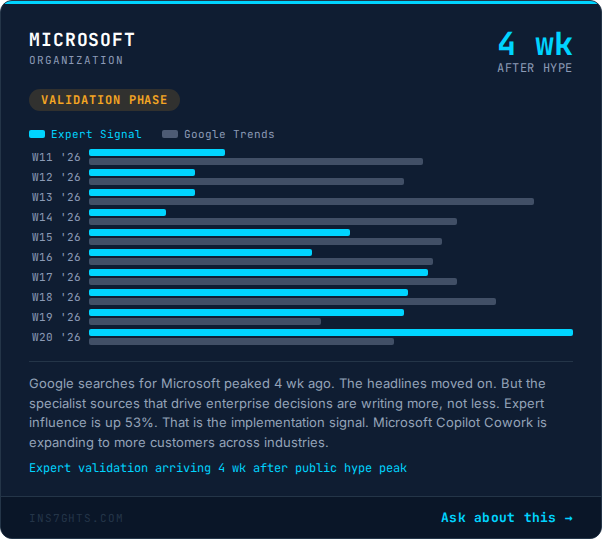
🔴 Noise: The big model names. ”AI,” ”machine learning,” Microsoft, and OpenAI pulled the most mentions across the wires this week but lost real influence, loud, familiar, and standing still. Anyone tracking ”AI news” by those four names is reading a 2024 frame while the room quietly moved to security, governance, and data integrity.
 From the 190K
We scanned 190,000 articles this week. Here's what no one's talking about:
Tenable bolted AI governance onto its security platform, MIT argued the semantic layer is the real infrastructure, and a BMJ study showed a pandemic quietly broke working machine-learning models, all in the same week.
Each desk reads these as unrelated. The security trade press covers the Tenable integration. The data-architecture crowd debates the semantic layer. The medical journals publish the drift study and move on. Read them on the same morning and a different picture emerges: the load-bearing layer of AI this week was not the model. It was everything underneath, who governs it, what business context feeds it, and whether the data still matches the world it was trained on. The familiar model names pulled the most mentions and lost influence, while security, governance, and data integrity gained it. The strategic move on Monday is to stop auditing which model you use and start auditing the foundation it stands on, because that's where this week's signal actually moved.
 By The Numbers
-
Iceotope raised $26 million to tackle AI data centers' thermal and power-density bottleneck — A funding round aimed squarely at the unglamorous physics of AI: the heat. Compute gets the headlines; cooling is where the next build-out actually stalls.
-
CuspAI landed $100 million to build an AI ”search engine for molecules” — The materials-discovery engine now powering Kemira's forever-chemicals work. This is what AI capital looks like when it buys a real-world outcome instead of another chat interface.
-
Nvidia backed Israeli AI unicorn Decart in a $300 million round — Real-time generative AI drawing a nine-figure check with the most strategic backer in the industry on the cap table. Watch where Nvidia invests, not just what it sells.
-
Upstream biologics titers of 3 to 5 g/L, and up to 10 to 13 g/L, are outpacing downstream purification capacity — The bottleneck quietly moved downstream, and real-time analytics, not bigger tanks, is the fix manufacturers are reaching for.
-
ArteraAI earned an FDA breakthrough device designation for its prostate tool before this week's commercial launch — The regulatory milestone that separates clinical AI you can bill from clinical AI you can only demo.
 Deep Dive: The Loud Names Lost The Room
Every DJ learns the same hard lesson early. The track everyone shouts for at midnight is rarely the one that actually holds the floor. The crowd names the obvious hit; the set lives or dies on the records underneath, the ones that keep the energy moving when the obvious choice would've emptied the room. This week the AI floor did exactly that. The names everyone shouted for got quieter, and the foundations carried the night.
The Mentions Lied
Look at what pulled the most coverage this week, and you'd think nothing changed: ”AI,” ”machine learning,” Microsoft, OpenAI, the usual marquee. But mentions are vanity. Real influence, the structural pull these names have on the rest of the conversation, slid for every one of them. They're being talked about out of habit, not because they moved the week. It's the difference between the band everyone's heard of and the band actually selling out shows right now.
The Quiet Layer Won
Underneath, a different set of names climbed: cybersecurity, regulatory compliance, risk assessment, data integrity. Not headline material. Exactly the stuff a CFO signs off on. The week's concrete moves matched the data, Tenable folding governance into security, MIT arguing for the semantic layer, a drift study reminding everyone that data ages. The foundation layer didn't just get attention. It got authority.
Davos Said The Quiet Part
The mood at the Davos AI Summit fit perfectly. Between the bubble warnings, Microsoft's Satya Nadella argued the only way to stop the boom becoming a bust is to ground stratospheric valuations in real-world utility. Another panelist put it sharper still: the true objective isn't to produce tokens, it's to create outcomes. Translation, the hype is repricing, and the survivors are the ones with a foundation under the valuation.
What Actually Works
-
Audit the foundation, not the model. Spend one review cycle on governance, data quality, and semantic context before you spend another euro on a model pilot. That's where this week's value moved.
-
Put a drift monitor on every production model. If the world has changed since training, your model is confidently wrong and nothing is alerting you. Make drift a tripwire, not a postmortem.
-
Wire governance into the tools people already use. AI risk that lives in a policy PDF doesn't get enforced. Tenable just showed the alternative: put it in the console the team opens every day.
-
Demand a citation for rules-based answers. Tax, compliance, clinical, contractual, if the AI can't point to the source, it's a liability, not an advisor. Make grounding a requirement in writing.
The crowd will keep shouting for the hits. The headline names will keep pulling mentions. But the set that holds the floor through the back half of this year is the one built on foundations nobody's filming. Mix for the floor that's still dancing in August, not the one yelling at midnight.
 What's Coming
World Models Move From Theory To Roadmap
The shift past next-token prediction toward models that build an internal picture of how the world works is moving from research papers into vendor roadmaps. Watch for ”world model” to become the next positioning word in enterprise pitches, and watch closely for which ones have substance versus a relabeled LLM.
The CSRD Compliance Clock Starts Forcing AI Into ESG
Continuous ESG reporting under the 2026 CSRD is about to make AI-powered compliance less optional and more deadline-driven. The reporting cadence is shifting from annual to continuous, and that's a data-pipeline problem before it's a sustainability one. Expect the audit committee to start asking your data team uncomfortable questions.
Sovereign AI Becomes A Procurement Checkbox
The UAE's national platform is the first clean template, and others will follow fast. ”Where does it run and who controls it” is moving from a geopolitical talking point to a line item on the RFP. If you sell cross-border, expect data-residency and sovereignty clauses to start gating deals.
 For Your Team
Strategic purpose: Monday is the day this week's signal gets turned into one decision before the next operating review. The week told you plainly where value moved, away from the model names and toward the foundation under them. The work is naming who owns that foundation, because right now in most organizations, nobody does.
Monday's meeting prompt: ”If the loudest AI names in the press lost real influence this week while security, governance, and data integrity gained it, then who in this room owns the foundation under our AI, the data quality, the semantic layer, the governance, and the drift monitoring, and is that one accountable person or four people who have never been in the same meeting?”
The Foundation Audit Framework:
-
Name a foundation owner. One accountable person for the data quality, semantic context, and governance under your AI, not a committee, a name.
-
Run a drift check on every production model. Compare current inputs to the training set; anything that's diverged gets flagged for retraining before the next decision rides on it.
-
Move governance into the daily tool. Whatever console your security or ops team already lives in, that's where AI-risk evidence belongs, not in a quarterly PDF.
-
Require a source for rules-based answers. Any AI touching tax, compliance, clinical, or contractual decisions must cite the regulation it's quoting, or it doesn't ship.
-
Add a ”where does it run” row. For every workload touching regulated or cross-border data, name the jurisdiction and the fallback. Sovereignty is becoming a contract term.
Share-worthy stat: This week the most-mentioned AI names, ”AI,” ”machine learning,” Microsoft, OpenAI, all lost real influence while cybersecurity, compliance, and data integrity climbed. Drop that on the next strategy call and the ”stop chasing model launches, fund the foundation” argument writes itself.
Go deeper: Track where influence is actually moving in real time →
 The Track of the Day
”The only way to prevent the boom from becoming a bust is to ground the technology's stratospheric valuations in tangible, real-world utility.”
— Satya Nadella, at the Davos AI Summit
Today's set closes on the record nobody requested but everybody needed: the foundation track. Defense, water treatment, the cancer clinic, the tax desk, and the security console all stepped into the AI buying seat this week, and not one of them cared which model topped a benchmark. The operator who reads only the model-launch headlines while security, governance, and data quality quietly become the comparable is going to play to a thinner floor by August. The one who walks into Monday with a named foundation owner is headlining the rest of the cycle.
Yves Mulkers, your data DJ, mixing 190,000 articles into the tracks that actually matter.
We scanned 190,000 articles this week so you don't have to. Data Pains → Business Gains.
Published: May 24, 2026 | Curated by Yves Mulkers @ Ins7ghts
1,300+ articles scanned. 7 stories selected. Our AI distills the noise into signal—in seconds. Get early access →
Know someone who'd find this useful? Share your unique referral link →
Want Your Own AI Intelligence Briefing?
Our platform analyzes 1,000+ sources daily and delivers personalized insights in seconds.
Join the Waitlist →Founding members: Lifetime discount • Priority access • Shape the product