
In partnership with


Your daily signal boost from 190,000+ articles, served with a DJ's ear for what actually matters.
 So, What Actually Happened?
Sunday morning, the inbox is a strange cocktail. The Pentagon spent the weekend naming seven tech companies as its operational AI partners, one of the largest IT services consolidators quietly bought a multi-thousand-engineer AIOps shop before Monday's earnings cycle, a major commercial real estate underwriter published a thesis arguing AI is rewriting tenant durability, and the BBC ran the first live AI avatar on broadcast television. We scanned 190,000 articles this week so you don't have to, and the bassline this morning is unmistakable. The headline AI race has stopped being about who has the biggest model. It is about who can lock in the procurement contracts, the operating muscle, and the cash-flow assumptions before the rest of the market catches up to the new map.
The Bottom Line: Friday belonged to the announcement. Sunday belongs to the architecture. The leadership team that walks into Monday with one named owner across procurement contracts, vendor consolidation, balance-sheet exposure, and the new content-truth pipeline sets the operating posture for the next four review cycles. Everyone else is going to spend the quarter chasing a map that was redrawn while they were drafting last week's plan.
Write docs 4x faster. Without hating every second.

Nobody became a developer to write documentation. But the docs still need to get written — PRDs, README updates, architecture decisions, onboarding guides.
Wispr Flow lets you talk through it instead. Speak naturally about what the code does, how it works, and why you built it that way. Flow formats everything into clean, professional text you can paste into Notion, Confluence, or GitHub.
Used by engineering teams at OpenAI, Vercel, and Clay. 89% of messages sent with zero edits. Works system-wide on Mac, Windows, and iPhone.
 The Tracks That Matter
1. The Pentagon Just Named Seven AI Partners In One Weekend, And Sovereign-AI Procurement Stopped Being A Slide On Someone's Roadmap
The single sharpest geopolitical-procurement signal of the weekend is sitting on a Daily Press wire most enterprise vendors will skim past. The US military reached AI deals with seven tech companies in a single named operational push, and the procurement document is no longer a ”we are exploring AI” pilot framework. It is a named partner list with named operational scope. Pair it with the Indian-press read on the same announcement, framing it as a strategic reset for adjacent allied procurement and a separate analyst tracking the agentic AI orchestration and memory systems market settling near $12 billion in orchestration frameworks alone by 2030, and the picture lines up. Defense procurement is moving from ”approve a model” to ”approve a named operating stack with named oversight,” and the rest of the regulated-sector procurement world is going to inherit the template inside two cycles.
The strategic implication is that the procurement scorecard for every regulated buyer just gained a ”named operational partner list” line. For two years, ”we use AI” was a vendor pitch. After this weekend, the question is ”who is on your named operator list, and what is the published scope of each one?” The CIO whose 2026 vendor scorecard still ranks AI suppliers by capability and price alone is reading from a 2024 model. The CIO who refactors the scorecard around named partners with named scopes, named oversight, and named decommissioning cadence will absorb the next twelve months of regulatory and customer scrutiny as routine operating updates.
The deeper signal is that this is the first procurement event large enough to drag every adjacent regulated buyer into the same template. Banks, insurers, hospitals, energy operators, and the large public-sector procurement offices in allied capitals all watch defense as the leading indicator on AI vendor governance. Expect the next twelve months to produce at least three published ”named operational AI partner list” templates from major financial regulators, expect at least one Tier-1 healthcare system to publish a named partner list with named clinical scopes, and expect the vendors who anchored this weekend's Pentagon deal to convert the reference into Fortune 500 procurement wins inside two quarters.
Here's what works: Before the next vendor-procurement review, ask one named question of the CIO and chief risk officer together: ”do we have a named operational AI partner list with named scope, named oversight cadence, and named decommissioning policy per partner, refreshed monthly?” If the answer is ”we have a vendor list,” that is the project. The Pentagon announcement is the trigger; the named operator list is the deliverable. The team that ships it first will close Q3 vendor renewals with credibility. The team that does not will be redrawing the procurement map after a regulator picks the template for them.
2. Cognizant Just Bought Astreya, And The IT-Services Consolidation Around Operational AI Quietly Crossed A Threshold
The cleanest M&A signal of the weekend is sitting on an MSP-channel wire that most strategy decks will not pick up before Monday. Cognizant agreed to acquire Astreya, folding a sizeable digital workplace and AIOps platform into one of the largest IT-services delivery footprints on the planet. Read it next to the Pega community write-up arguing the GenAI agent technology stack now requires an integrated control plane, not a tool collection, and an analyst note projecting the agentic-AI orchestration market at $12 billion by 2030 in orchestration frameworks alone, and the operating thesis sharpens. The IT-services market is consolidating around named ”AI operations” stacks the way it consolidated around named ”cloud migration” stacks five years ago, and the firms not buying their way to a stack by Q4 are going to be selling labor-arbitrage hours into a buyer who has stopped paying for them.
The strategic implication is that the IT-services vendor scorecard just got a new line item: ”named integrated AI operations stack with named outcomes, not named hours.” For two decades, IT-services procurement scored vendors on rate cards, near-shore mix, and named delivery centers. The Cognizant and Astreya pairing is the early signal that the next round of large-services contracts is going to be priced around outcomes the integrated stack delivers (mean time to incident, agent-decision audit cadence, model-risk attestation throughput) and not around the labor it consumes. The CIO whose 2026 services contract is still priced per FTE is reading from a 2022 procurement playbook. The CIO who insists on named outcome metrics priced against an integrated AI operations stack will renegotiate Q4 contracts from a position of architectural credibility, not vendor goodwill.
The deeper signal is that the consolidation wave is going to wash through the mid-tier services market inside three quarters. When the named leader in adjacent procurement categories (workplace + AIOps) merges its delivery motion, every smaller boutique that still sells ”we have a Fortune 500 AI practice” gets repriced inside two cycles. Expect at least three more named ”IT-services + AIOps + integration” acquisitions by Q3, expect the first Tier-2 boutique to announce a named ”AI operations outcomes” pricing model by Q4, and expect the buyer who has not yet renegotiated services pricing on outcome terms to walk into the Q1 2027 audit committee with a budget variance the CFO did not predict.
Here's what works: Before the next IT-services committee, ask one named question of the CIO and chief procurement officer together: ”for our top three services contracts, are we pricing on an integrated AI operations stack with named outcomes, or on FTE labor with a sprinkle of AI tooling?” If the answer is the second one, that is the project. The Cognizant and Astreya deal is the trigger; the outcome-priced services contract is the deliverable. The CIO who flips the contract first will pay 2026 prices for a 2027 service definition. The CIO who waits will pay 2027 prices for 2024 hours.
Try It Yourself
Your Analytics Stack Is One Database Too Many

Pipelines, backfills, sync lag, data drift… that's the cost of splitting your stack. Tiger Cloud extends Postgres, fully managed, so analytics run on live data. No second system. Stay on Postgres. Scale on Postgres.Try Tiger Cloud free.
3. Walker Dunlop Just Argued AI Is Rewriting Commercial Real Estate Income Durability, And The Investment Committee Map Just Got Redrawn
The single most under-covered cross-domain signal of the weekend is sitting on a commercial-real-estate research desk most data and AI leaders will never read. Walker Dunlop published a long thesis arguing that AI is reshaping which tenant incomes are actually durable, and that the traditional ”high income equals safe tenant” assumption no longer holds in an economy where labor displacement is moving up the income ladder, not down it. Pair it with a substack synthesis arguing that as AI accuracy increases, humans become more dependent and less skeptical and a practitioner note that ”second-order thinking” is the difference between AI that works and AI that fails, and a different operating thesis is starting to land. The conversations on AI strategy, AI safety, and AI economic impact have stopped being separate boardroom topics. They have folded into one strategic question: ”which assumptions on our balance sheet, our operating budget, and our customer base are about to be repriced by AI moving up the value chain?”
The strategic implication is that the investment committee scorecard just gained an ”AI durability” column. For two decades, real estate underwriting weighted high-income knowledge worker tenants as low risk. Walker Dunlop's argument names the inversion: the same legal-services firm that anchored a Class-A office tower in 2018 may be the tenant most exposed to billable-hour collapse in 2027, and the same tower's industrial-tenanted comparable may turn out to be the durable income story. The CFO whose 2026 capital-allocation model still treats ”knowledge work” as inherently safer than ”physical operations” is reading from a 2019 underwriting framework. The CFO who runs an explicit AI-displacement stress test on the top ten income-generating assets, and prices the durability accordingly, will close Q3 with the cleaner balance sheet.
The deeper signal is that the conversation just connected three desks that almost never share a memo: the data and AI strategy desk, the commercial real estate underwriting desk, and the workforce planning desk. Each owns a piece of the same emerging risk: which roles, which firms, and which industries hold income durability in an AI-accelerated economy. Expect at least two large insurers to publish named ”AI displacement underwriting” methodology by Q4, expect at least one major REIT to disclose a named ”AI exposure” line on its quarterly tenant report inside twelve months, and expect the first wave of pension-fund allocators to price ”AI displacement risk” into the next round of commercial real estate fund mandates by Q1 2027. The fund managers who ran the integrated stress test now will negotiate from named evidence. The ones who did not will be writing the evidence into the next quarterly redemption letter.
Here's what works: Before the next investment-committee review, run a named exercise on the top five income-generating assets in the portfolio: ”what share of the tenant base sits in roles where AI is documented to be repricing labor hours over the next 24 months, and what is the durability scenario at 50 percent labor displacement, 25 percent rent compression, and a two-year vacancy hit?” If the answer is ”we have not modeled it,” that is the project. The Walker Dunlop thesis is the trigger; the named AI-displacement stress test is the deliverable. The data and AI leader who runs the stress test in partnership with the underwriting desk will deliver the cleanest balance-sheet story of the quarter. The one who keeps the conversation in two separate departments will read about it in a Q1 2027 fund-redemption letter.
4. The BBC Just Ran The First Live AI Avatar On Broadcast Television, And The ”What Is Real” Pipeline Just Walked Into Every Newsroom
The cleanest ”this changes the production stack” signal of the weekend is sitting on a Runway customer story most enterprise leaders will never see. BBC Studios brought a live AI avatar to broadcast television for the first time, with a fully named on-air presenter rendered through a generative AI pipeline. Read it alongside the Politico magazine piece arguing that even a friend of Elon Musk thinks he is wrong about how AI risk should be framed and the same week's Adobe Lightroom rollout extending content credentials further into the creator pipeline, and the operating picture sharpens fast. The ”what is real” pipeline has stopped being a 2027 hypothetical. It is being built into broadcast workflows this week, into creator workflows last week, and into the legal-and-regulatory map for the rest of the year.
The strategic implication is that every customer-facing communication channel just gained a new attestation requirement. For three years, ”synthetic media” was a legal team's footnote. After the BBC milestone, the question is ”for every customer-facing video, image, voice clip, and on-air presenter, do we have a named provenance attestation, a named human reviewer, and a named retention period?” The chief marketing officer who walks into the next brand-safety review with named provenance across the content stack moves cleanly through the next regulatory cycle. The CMO whose pipeline still ships content with no named attestation is going to spend Q3 and Q4 retrofitting compliance into a content stack that was not designed for it.
The deeper signal is the inversion of the trust posture in major media operations. For decades, broadcast credibility came from the institution behind the camera. After the BBC milestone, broadcast credibility will increasingly come from the named provenance metadata travelling with every frame and every soundwave. Expect at least two more major broadcasters to ship a named live-AI presenter inside twelve months, expect the first wave of newsroom guidelines mandating named provenance attestation on synthetic content to land by Q3, and expect the consumer-platform players to start surfacing provenance metadata in user feeds by Q4. The brand that ships the named provenance pipeline first will own the trust narrative. The brand that does not will spend the next three years explaining why a single deepfake incident reset the operating posture.
Here's what works: Before the next brand-safety committee, ask one named question of the chief marketing officer and general counsel together: ”for every customer-facing piece of synthetic or AI-augmented content in our pipeline, do we have a named provenance attestation, a named reviewer, and a named retention period, and do those stand up under a regulator's named documentation request?” If the honest answer is ”we are working on it,” that is the project. The BBC milestone is the trigger; the named provenance pipeline is the deliverable. The brand that ships it first will absorb the next deepfake incident as a routine content-ops event. The brand that does not will read about itself in a regulator press release.
Claude is not just a chatbot anymore. Is your security team ready?
Claude.ai is one thing. Claude Cowork with MCP connections, running agentic workflows, taking actions across your data with ungoverned skills? That is a different conversation entirely, and most security teams are not equipped to govern it.
Harmonic Security is built to secure everything Claude offers. Full browser controls for Claude.ai, deep governance over agentic MCP workflows, and real-time visibility into what Claude is doing across your organization. So your CISO can say yes to the tools your business is already demanding.
5. The Contrarian Read On AI Risk Just Got A Public Endorsement, And The ”Killer Robots” Frame Just Lost A Round
The single most useful contrarian signal of the weekend is sitting on a Politico magazine read that most enterprise strategy decks will not surface. A long-time friend of Elon Musk publicly argued that Musk's ”killer robots” framing of AI risk is misdirected, and that the operationally meaningful risk is the slow, mundane drift of AI into decision pipelines without named accountability. Pair it with the Intercept piece tracking the legal positioning ahead of Musk's OpenAI lawsuit trial, and the JPMorgan executive last week naming the AI decision audit trail as the one variable holding enterprise AI back, and the picture is consistent. The most influential public AI-risk frame is being publicly walked back by the people closest to its origin, and the operating risk that actually shows up in board-level audits has nothing to do with sci-fi and everything to do with mundane decision-trail discipline.
The strategic implication is that the AI-risk slide in every C-suite deck just got a new headline. For two years, AI risk was framed in the language of catastrophic scenarios. The shift names the actual operating frontier: every consequential decision an AI system influenced in the last 90 days needs a named owner, a named audit trail, a named human reviewer, and a named retention period. The chief risk officer who walks into the next board review leading with the named decision-trail framework, and not with the ”killer robots” frame, will move two cycles cleaner than the CRO still using public anxiety to justify the budget. The board listens to the operating frame, not the entertainment frame, when the regulator's letter arrives.
The contrarian read is that the public discourse just bought enterprise leaders 90 days of operating cover. The press is still working through the headline-grabbing risk frame. Boards reading the more sophisticated commentary have already moved on to the mundane operating discipline. The CISO and CRO who use the next 90 days to ship the named decision-trail framework, the named AI agent registry, and the named provenance pipeline will land Q3 with a defensible posture. The ones who keep deferring those projects on the assumption that ”AI safety” is a 2027 problem will spend Q1 2027 in front of an audit committee with a half-built spreadsheet.
Here's what works: Before the next risk-and-controls committee, reframe the AI-risk slide. Drop the catastrophic-scenario language. Lead with three named operating frames: the named decision-trail owner, the named agent registry, and the named provenance pipeline. The Politico framing is the trigger; the operationally grounded risk slide is the deliverable. The CRO who ships the new slide first will close out the next regulator examination cleanly. The one who waits will be writing the named owner into a response memo while the examiner waits in the conference room.
6. Cyberhaven Just Named Three Pillars Of Data Security, And Most Programs Are Built For Two Of Them
The single most under-covered security architecture signal of the weekend is sitting on a vendor blog most CISOs will skim past. Cyberhaven published a sharp three-pillar framing for data security: presence (where data is), lineage (how data moves), and AI (how data is consumed by models and agents). Read it next to the Databricks blog distinguishing ”model risk governance” from ”risk intelligence” and arguing the two are not the same operating discipline and the PwC analysis that most in-scope firms are not on track to meet the EU AML overhaul, and the architecture starts to come into focus. The traditional data security stack covers presence and lineage. Almost no program in production today covers the third pillar, ”what AI does with the data,” with the same rigor.
The strategic implication is that the data-security architecture just gained a procurement-line item: ”AI consumption controls and audit trail.” For a decade, data-security spend went to discovery and lineage tools. After the Cyberhaven framing, the question is ”for every AI agent in production touching customer data, model-training data, or regulated data, do we have a named control surface, a named consumption log, a named retention policy, and a named owner?” The CISO whose 2026 program still treats AI consumption as a downstream concern of an existing data-loss-prevention tool is reading from a 2023 architecture. The CISO who refactors the program around the third pillar, with named controls and named owners, will absorb the next 18 months of audit and regulatory pressure as routine operating updates.
The deeper signal is that the third pillar is the one that closes the audit-trail discipline that JPMorgan executives, federal banking guidance, and the agentic-sprawl playbook have all named in the last fortnight. Without the AI consumption layer, the named decision-trail discipline, the named agent registry, and the named provenance pipeline all leak at the seams. Expect at least three Big-Four firms to publish a named ”third pillar” advisory inside twelve months, expect the first major bank or insurer to add a ”third pillar attestation” to its annual report by Q4, and expect a wave of vendor consolidation in data-security tooling around the named consumption-control category by Q1 2027.
Here's what works: Before the next security architecture review, ask the CISO and chief data officer one named question together: ”for our top three production AI agents touching regulated data, do we have a named consumption log, named control surface, named retention policy, and named owner of the AI consumption pillar?” If the honest answer is ”we have presence and lineage but not consumption,” that is the project. The Cyberhaven framing is the trigger; the named third-pillar architecture is the deliverable. The CISO who ships it first pulls 18 months of operating discipline ahead of peers still treating AI consumption as a tool-level concern.
7. Workhuman Just Bet The HR Operating Model On Data, AI, And Experience, And The Workforce Analytics Map Quietly Got A New Center Of Gravity
The cleanest enterprise-software signal of the weekend is sitting on a Futurum analyst note that most CIO decks will not pick up. Workhuman, the Dublin-based recognition and people-analytics platform, named data, AI, and experience as the three pillars of its next operating model, with a sharp pitch that workforce analytics is the only enterprise app category where AI directly improves the data quality of the underlying signal as it operates. Pair it with the Avangrid prompt-a-thon program named as a workforce-development AI initiative for a Fortune-500 utility and the globenewswire research note that the AI-for-drug-discovery market is opening new innovation and collaboration windows for biotech-pharma partnerships, and a quieter operating thesis lands. The HR analytics, workforce-development, and domain-specific AI categories have stopped being separate procurement conversations. They are folding into one named ”people and outcomes” stack, and the firms that integrate first will absorb the next two cycles of vendor consolidation as routine architectural updates.
The strategic implication is that the chief people officer's 2026 vendor map just gained a new center of gravity. For five years, HR-tech procurement was scored on payroll, ATS, LMS, and engagement modules. After the Workhuman framing, the question is ”do we have a named people-analytics stack with named feedback loops between recognition data, performance signal, and AI-augmented decision support?” The CPO whose 2026 procurement still scores HR modules in isolation is reading from a 2022 model. The CPO who insists on named integration with the AI agent layer, named feedback into the workforce-planning model, and named outcomes priced against retention and productivity will absorb the next 18 months of HR-tech consolidation as a strategic positioning win.
The deeper signal is that workforce analytics is becoming the load-bearing layer for every other AI program in the firm. Without named visibility into where the AI is replacing labor hours, where it is augmenting decisions, and where it is creating new role categories, the broader AI portfolio runs blind. Expect at least three named ”AI workforce intelligence” vendor consolidations inside twelve months, expect the first wave of HR-tech buyers to start pricing modules on integrated outcomes rather than per-seat licensing by Q4, and expect a Big-Four advisory firm to publish a named ”AI workforce intelligence reference architecture” by Q3.
Here's what works: Before the next HR-tech committee, ask the chief people officer and chief data officer one named question together: ”do we have one named integrated workforce analytics stack covering recognition data, performance signal, AI-augmentation visibility, and workforce-planning forecasts, with named outcome metrics, or do we have five separate dashboards?” If the answer is the second one, that is the project. The Workhuman framing is the trigger; the integrated workforce analytics stack is the deliverable. The CPO who ships it first will run Q4 vendor renewals from a position of named operating evidence. The one who does not will pay per-seat licensing for tooling that should have been priced on retention and productivity outcomes.
 Signal vs. Noise
🟢 Signal: Data Analytics structural influence climbed 20 percent on a 297-article base, Data Governance influence rose 37 percent on a 153-article base, and the broader Analytics conversation gained 60 percent of real influence on a 149-article base. The pattern under those numbers is what matters. Analytics and governance coverage has been growing for months; the new shift this week is that the conversation has stopped being about generic ”we need a dashboard” and started being about named operating categories with named procurement implications: integrated workforce analytics, named decision-trail discipline, the third pillar of data security, AI-displacement underwriting, named provenance attestation. Real-world influence rising while raw mention volume mildly cools means the conversation has moved from ”should we worry about this” into ”who owns this on Monday morning.” The chief data officer who walks into Monday's operating committee with the named owners and the integrated reference architecture moves two cycles cleaner than the CDO still framing analytics as a 2027 maturity question.
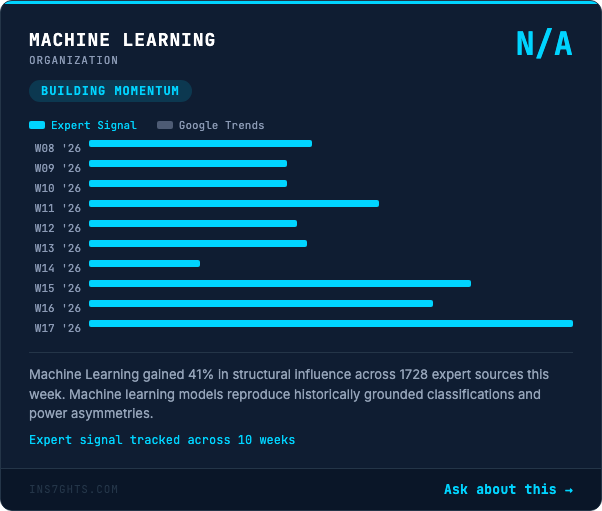
🔴 Noise: Machine Learning still pulled 385 mentions but lost 20 percent of structural influence over the week, Artificial Intelligence as a single block pulled 328 mentions while shedding 33 percent of real influence, and ”Regulatory Compliance” as an undifferentiated header pulled 319 mentions while losing 52 percent. All three labels are still attached to a lot of announcements; the operational conversation has moved past them as undifferentiated headers. ”Machine Learning” has been replaced by sharper categories: integrated AI operations stacks, named agent registries, AI consumption logs. ”Artificial Intelligence” has fragmented into named operator categories: orchestration platforms, decision-trail systems, integrated workforce analytics. ”Regulatory Compliance” has been replaced by DELETE Act, FinCEN AML, EU AML overhaul, agentic sprawl governance. Procurement intake filters keyword-screening on those legacy generic terms are filtering for vendor marketing, not buyer signal. Rebuild the filter around the named operating categories and inbound vendor relevance doubles inside two months.
 From the 190K
We scanned 190,000 articles this week. Here's what no one is talking about:
The pattern of the day is that AI is finally being repositioned from an ”innovation conversation” into an underwriting conversation, and five very different desks discovered they all own a piece of the same balance-sheet question, with almost none of them coordinating yet.
Watch the desks separately and you would call this five unrelated stories. The chief information officer is processing a Pentagon partner-list announcement that names sovereign-AI procurement as the new template. The chief financial officer is processing a commercial real estate thesis that names AI-displacement risk as the new tenant durability question. The chief marketing officer is processing a BBC live-avatar milestone that names provenance attestation as the new content-credibility line. The chief information security officer is processing a Cyberhaven framing that names AI consumption as the new third pillar. The chief people officer is processing a Workhuman bet that names integrated workforce analytics as the new HR-tech center of gravity. Read them as one substrate and the picture sharpens fast. The five conversations are about the same underlying line item: which of our 2024 underwriting assumptions are about to be repriced by AI moving up the value chain, and most operating committees have not yet given the five owners a shared dashboard.
The operational implication is that the 2026 underwriting cycle will be won by the firm that consolidates these five conversations into one named ”AI Underwriting Review,” with one integrated owner, one integrated dashboard covering procurement contracts, balance-sheet exposure, content provenance, AI consumption controls, and workforce analytics, and one integrated quarterly cadence. The firms that let the five conversations run in parallel will discover the duplication in the Q4 audit, when the cost of consolidating after the fact is two to three times the cost of consolidating before. The firms that consolidate now will run AI portfolios with a single named owner, fewer surprise variances, and a real signature on every consequential decision when the first regulator examination lands.
🔍 Below the surface: Here's how you spot real infrastructure: 380 articles cite the Data Analytics conversation with rising structural influence, 153 articles cite Data Governance the same way, and the operating frame quietly shifting both is the move from ”tooling” to ”named operating discipline with named owners.” That shift does not show up in any vendor leaderboard. It shows up in the integration patterns, the role redefinitions, and the procurement vocabulary. The trade publications pulling these threads together (the security press, the HR-tech press, the commercial real estate research desks, the broadcast-tech press, and the regulatory press) are running a quarter ahead of the analyst houses, which are running two quarters ahead of operating-committee dashboards. The firms that read the trade press of the operating function adjacent to their own are reading next quarter's variance commentary before it is written.
 By The Numbers
- The Pentagon named seven tech companies as operational AI partners in a single procurement announcement — The cleanest single-line reframe of the regulated-procurement conversation in months. Drop it on the next vendor-procurement deck and the ”approve a model” language reframes itself in 30 seconds.
- The agentic AI orchestration and memory systems market is projected to reach roughly $12 billion in orchestration frameworks alone, accounting for 32 percent of the broader category, by 2030 — The cleanest leading indicator that ”orchestration” has crossed from feature into named procurement category. CIOs whose 2026 vendor scorecard still rolls orchestration into ”AI tooling” are reading from a 2024 operating model.
- A senior JPMorgan executive named the audit trail of AI-influenced decisions, not compute or model accuracy, as the single variable holding enterprise AI back — Carry-forward from last week, sharper this week. The named decision-trail discipline is the load-bearing wall the next round of regulator letters will be built around.
- PwC research finds that most in-scope firms are not on track to meet the EU AML overhaul named compliance milestones — The named gap has a procurement signature attached: vendors who can demonstrate the named pattern monitoring on the named cadence will absorb the procurement queue inside two cycles.
- BBC Studios ran the first live AI avatar on broadcast television through a Runway-built generative pipeline — The ”what is real” pipeline just walked into the broadcast newsroom. Brand-safety teams whose 2026 plan does not yet include a named provenance attestation line are reading from a 2024 content stack.
- IBM Db2 12.1.5 shipped with explicit ”innovating for enterprise-level AI and availability” framing, naming the database tier as the operating constraint, not the model — The unsexy news of the week is also the most operationally relevant: the database tier is where AI scaling either works or breaks. Most 2026 budgets do not name it.
- Data Analytics structural influence climbed 20 percent week over week and Data Governance climbed 37 percent, while ”Machine Learning” as a generic label shed 20 percent and ”Artificial Intelligence” as a generic label shed 33 percent — The signature of categories that have crossed from undifferentiated header into named operating language. Procurement filters still keyword-screening on the legacy generic terms are filtering for vendor marketing, not buyer signal.
- Cross-Functional Collaboration appeared as a bridge concept across analytics engineering, data engineering, generative AI, and Databricks domains in the same week — The cleanest leading indicator that the operating frame inside enterprise AI has shifted from ”tool ownership” to ”shared accountability across the named operator stack.” The CTO whose dashboard still leads with ”AI initiatives” as a single bucket is two cycles behind operator-grade peers.
 Deep Dive: The 2024 Underwriting Assumptions Are Quietly Being Repriced By AI, And Most Boards Are Looking At The Wrong Slide
Every DJ who has ever played a long set at a corporate event knows the moment when the room shifts. The first hour is the headline track, the obvious crowd-pleaser, the reason the booking happened. But somewhere into the second hour, the dancefloor stops responding to the headline track, and the energy starts moving to the support act, the unexpected groove, the bassline nobody booked but everybody is now moving to. That is what this weekend's news told us about AI. The set was 2024 and 2025. The room shifted this week, and the boards still leading with the 2024 headline track are about to play to a half-empty floor.
The Procurement Side Of The Underwriting
The Pentagon partner-list announcement is the bass drop. Every announcement that names ”named operational AI partner with named scope and named oversight” is the early signal that the procurement map is consolidating around named accountability, not point-tool capability. The CIO whose 2026 vendor scorecard is still organized around model benchmarks and rate cards is reading from a 2024 narrative. The CIO who refactors the scorecard around named operator stacks with named outcomes per stack will renegotiate Q4 contracts from a position of architectural credibility, not vendor-permission asking.
The Balance-Sheet Side Of The Underwriting
The Walker Dunlop commercial real estate thesis is the snare. The argument is not pricing yet another office tower. It is pricing the assumption that ”high-income knowledge worker tenants are inherently safer” against the named risk that AI is climbing the income ladder, not replacing the bottom of it. The CFO who walks into the next investment committee with an AI-displacement stress test on the top ten income-generating assets, and a named durability scenario at 25 percent rent compression, lands Q3 with the cleanest balance sheet. The CFO still pricing 2018 tenant assumptions against 2027 income reality will be writing variance commentary in a Q1 2027 redemption letter.
The Trust Side Of The Underwriting
The BBC live-avatar milestone is the hi-hat. It runs underneath every other section of the night. Take it out, keep shipping content with no named provenance attestation, and the entire customer-credibility posture starts to drift. The CMO who adds a named provenance pipeline to the Q3 plan, and the chief content officer who ships a named human-reviewer cadence, are the two roles that win the next deepfake incident cleanly. Every other brand is going to be writing a press apology while the regulator letter waits in the inbox.
The Operating Side Of The Underwriting
The Cyberhaven third-pillar framing and the Workhuman workforce analytics bet are the operating muscle's vocal hook. The line is unmistakable: the data-security stack just gained a named third pillar (AI consumption), and the HR-tech stack just gained a named center of gravity (integrated workforce analytics). The CISO who refactors the data-security program around presence, lineage, and consumption with one named owner per pillar will absorb the next 18 months of audit pressure as routine operating updates. The CPO who refactors the people stack around recognition data, performance signal, and AI-augmentation visibility with one named integrated owner will land Q4 with a defensible workforce strategy.
What Actually Works
- Stand up an AI Underwriting Review with one named owner. CIO, CFO, CMO, CISO, and CPO co-sign. One integrated dashboard covering procurement contracts, balance-sheet exposure, content provenance, AI consumption controls, and integrated workforce analytics. Refreshed monthly. Without it, the five accountability conversations land separately and contradict each other.
- Refactor the AI vendor scorecard around named operator stacks, not point tools. Every vendor evaluation gets one accountable owner per stack, one named SLA, and one named integration commitment. Per-tool procurement is the 2024 assumption.
- Run an AI-displacement stress test on the top ten income-generating assets in the portfolio. Named scenarios at 25 percent rent compression, 50 percent labor displacement, and a two-year vacancy hit. The Walker Dunlop thesis named the question; the named stress test is the project.
- Ship the named provenance pipeline and the named third-pillar architecture. Every customer-facing content asset gets a named attestation, named human reviewer, and named retention period. Every production AI agent touching regulated data gets a named consumption log, named control surface, and named owner. Quarterly cadence.
The set list is changing because the underlying underwriting line is real. The DJ who keeps spinning the headline model (look at the new benchmark, look at the new partnership, look at the new round) to a room that has already moved to the second stage of ”which of our 2024 assumptions just got repriced” is going to lose the corporate booking. The DJ who hears the bassline of the underwriting shift, names the line items, and mixes the next verse around them is the one whose Monday morning calendar fills up. The underwriting is the support act. Mix it for the bassline the room is already moving to.
 What's Coming
The First Tier-1 Bank To Publish A Named ”AI Decision Trail Owner” In The Chief Risk Officer Mandate
The JPMorgan framing carried into this weekend through Cyberhaven's third-pillar architecture. The next move is the first US or European Tier-1 bank to publish an updated chief risk officer mandate that names a senior AI Decision Trail Owner with audit-cycle reporting accountability. That update is probably one to two quarters out. The CROs who have already drafted the role split will fold the mandate update in cleanly. The CROs that have not will be writing the role description while the regulator's next examination cycle starts.
The First Major REIT To Disclose A Named ”AI Exposure” Line On The Quarterly Tenant Report
The Walker Dunlop thesis is the trigger. The next move is the first major real estate investment trust to publish an ”AI exposure” disclosure on the quarterly tenant report, with named tenant categories scored for AI-displacement risk and named scenarios on durability. That announcement is probably one to two quarters out. The fund managers who ran the integrated stress test now will negotiate from named evidence. The ones who did not will be reading the disclosure standard in the trade press six months later.
The First Major Broadcaster To Publish Named Provenance Guidelines For Synthetic Content
The BBC live-avatar milestone is the trigger. The next move is the first Tier-1 broadcaster (BBC, Sky, NBC, ARD, France Televisions) to publish named newsroom guidelines mandating provenance attestation, named human reviewer, and named retention period for all synthetic content. That announcement is probably one quarter out. The newsrooms that have already drafted the guidelines will read the public version with the work already done. The ones that have not will spend the next quarter writing the guidelines under regulator pressure rather than editorial choice.
 For Your Team
Strategic purpose: Sunday is the day this week's signals get translated into a single integrated AI Underwriting Review before Monday's operating committee. The work today is not another briefing. It is the conversation that names one signature line across procurement contracts, balance-sheet exposure, content provenance, AI consumption controls, and integrated workforce analytics. Everything else is commentary.
Monday's meeting prompt: ”If the Pentagon just named seven tech companies on a single operational AI partner list, Walker Dunlop just named AI as the variable repricing tenant durability, and the BBC just named provenance attestation as the new content-credibility line in the same weekend, who in this room owns the named one-page AI Underwriting Review across procurement contracts, balance-sheet exposure, content provenance, AI consumption controls, and integrated workforce analytics, and is that owner one person or five?”
The AI Underwriting Review Framework:
- One named owner across five lines. CIO, CFO, CMO, CISO, and CPO co-sign one underwriting plan. One page, one cadence, one dashboard. If the five accountability conversations land on separate desks with separate owners, the framework is not real.
- Named operational AI partner list with named scopes. Every regulated-buyer procurement file gets one accountable owner per partner, one named scope of work, and one named decommissioning policy. Generic vendor lists are the 2024 assumption.
- AI-displacement stress test on the top ten income-generating assets. Named scenarios at 25 percent rent compression, 50 percent labor displacement, and a two-year vacancy hit. The Walker Dunlop framing named the question; the named stress test is the project.
- Named provenance pipeline across customer-facing content. Every synthetic or AI-augmented asset gets a named attestation, named reviewer, and named retention period. The BBC milestone named the category; the named pipeline is the deliverable.
- Named third-pillar architecture for data security. Presence, lineage, AND AI consumption, with one named owner per pillar and a named consumption log per production agent touching regulated data. The Cyberhaven framing named the gap; the named architecture is the project.
Share-worthy stat: The Pentagon named seven tech companies as operational AI partners in a single procurement announcement, and the agentic-AI orchestration market is projected to hit $12 billion in orchestration frameworks alone by 2030. Drop both on the next vendor-procurement deck and the ”approve a model” conversation reframes itself in 30 seconds.
Go deeper: Track the AI underwriting signals in real time →
 The Track of the Day
”AI will free you for the hard work of figuring out what actually matters. You don't have to memorize everything anymore, but you still have to do the hard part: deciding what matters. That's on you. Let's make sure you're really good at it.”
— Cassie Kozyrkov, May 2, 2026
Today's set: ”Once In A Lifetime” by Talking Heads, mixed into ”Slow Burn” by Kacey Musgraves. Talking Heads named the moment that walked into every operating committee on Sunday morning, the moment when the question is ”well, how did I get here,” and the answer is that the underwriting assumptions changed while everyone was watching the headline model race. Kacey Musgraves named the answer: the right play is the slow burn, the one named owner across five lines, the disciplined rebuild of procurement contracts, balance-sheet stress tests, provenance pipelines, AI consumption controls, and integrated workforce analytics. A Pentagon partner-list announcement that consolidates sovereign AI procurement into a named template. A Cognizant and Astreya deal that consolidates IT services around a named AI operations stack. A Walker Dunlop thesis that names AI displacement as the new tenant durability question. A BBC live-avatar broadcast that names provenance attestation as the new content-credibility line. The DJ who keeps spinning the headline model is going to play last quarter's set to a room that has already rotated to the second stage of ”which 2024 assumption just got repriced.” The DJ who hears the support act of the underwriting shift, names the line items, and mixes the next verse around them is the one whose Monday morning meeting books the rest of the quarter. Everybody else is still trying to find the headliner on a USB the room has stopped asking for.
Yves Mulkers, your data DJ, mixing 190,000 articles into the tracks that actually matter.
We scanned 190,000 articles this week so you don't have to. Data Pains → Business Gains.
Published: May 3, 2026 | Curated by Yves Mulkers @ Ins7ghts
1,300+ articles scanned. 7 stories selected. Our AI distills the noise into signal—in seconds. Get early access →
Know someone who'd find this useful? Share your unique referral link →
Want Your Own AI Intelligence Briefing?
Our platform analyzes 1,000+ sources daily and delivers personalized insights in seconds.
Join the Waitlist →Founding members: Lifetime discount • Priority access • Shape the product