
In partnership with


 So, What Actually Happened?
So, Friday. The week spent its energy arguing about which model is smartest, and then the real money quietly walked over to the boring question nobody wants on a slide: can you even find your own data? Neo4j bought GraphAware to wrap an intelligence layer around the graph, and an enterprise survey landed the gut-punch of the week, 79% are sure they can scale AI, only 29% can locate the data it would run on. We scanned 190,000 articles this week so you don't have to. Meanwhile Supabase hit a $10.5 billion valuation as infrastructure ate the spotlight, and a room full of mathematicians warned that AI is corrupting how proofs get checked.
The Bottom Line: The model got cheap, the data got loud. This week the money and the worry both moved to the same place: finding, connecting, and trusting the data underneath the AI, not the AI itself.
Your prompts are leaving out 80% of what you're thinking.

When you type a prompt, you summarize. When you speak one, you explain. Wispr Flow captures your full reasoning — constraints, edge cases, examples, tone — and turns it into clean, structured text you paste into ChatGPT, Claude, or any AI tool. The difference shows up immediately. More context in, fewer follow-ups out.
89% of messages sent with zero edits. Used by teams at OpenAI, Vercel, and Clay. Try Wispr Flow free — works on Mac, Windows, and iPhone.
 The Tracks That Matter
1. Neo4j Buys GraphAware To Turn Graphs Into Intelligence
Let me start with the one that hits home, because I've spent twenty years arguing that connecting data beats collecting it. Neo4j acquired GraphAware to launch an intelligence layer on top of the graph database, folding a long-time partner's analytics tooling directly into the core product. Translation: the company that sells the connections is now selling what you do with them.
The timing is the tell. This lands the same week the legal world started arguing that the source of your data is becoming the central question, not a footnote. A graph is just the cleanest way to answer ”where did this come from and what is it connected to” at scale. When lineage stops being an IT nicety and becomes a legal control, the boring graph database in the back becomes the system of record everyone suddenly needs.
The strategic read travels past one vendor. For two years the AI conversation was about reasoning. This deal is a bet that the next fight is about relationships, knowing how your customers, contracts, and systems actually link together, because that's the context a model needs and the thing a keyword search can't see. The smartest model on disconnected data is a brilliant DJ with the records in random order.
Here's what works: Before you fund another model pilot, ask whether your data can even be traced and connected. If you can't draw the map of how your core entities relate, you don't have an AI problem, you have a graph problem, and that's the cheaper one to fix first.
2. Supabase Hits $10.5 Billion As Infrastructure Eats The Spotlight
Here's the funding number that should reframe where you think the value lives. Supabase, the open-source database-and-backend company, reached a $10.5 billion valuation, with the same deal sheet showing Generalist closing $2 billion and York Space getting bought. Notice what investors paid up for: not a flashy consumer AI app, but the plumbing developers build on.
The pattern is consistent with the whole week. When the application layer gets commoditized by whatever model is hot this month, the durable money flows to the foundation that every app sits on, the database, the auth, the storage, the connective tissue. A $10.5 billion valuation for ”the boring backend” is the market saying the same thing the headlines won't: the picks-and-shovels layer is where the defensible business is.
That's the quiet repricing. Two years ago the premium sat on the model. Now it's sliding onto whoever owns the place your data actually lives and moves. The application is the song everyone can cover now. The infrastructure is the venue, and you can't play a gig without one.
Here's what works: When you evaluate your AI stack, follow the money to the foundation layer. Ask which of your vendors owns your data's home base, because that's where your switching costs and your leverage both live. The app you can swap in an afternoon. The backend you're married to for years.
Try It Yourself
The IT strategy every team needs for 2026

2026 will redefine IT as a strategic driver of global growth. Automation, AI-driven support, unified platforms, and zero-trust security are becoming standard, especially for distributed teams. This toolkit helps IT and HR leaders assess readiness, define goals, and build a scalable, audit-ready IT strategy for the year ahead. Learn what’s changing and how to prepare.
3. 79% Trust Their AI, Only 29% Can Find The Data
Here's the stat that should land on every leadership table, not just the data team's. A new enterprise survey found that 79% of companies are confident they can scale AI without breaking governance, while only 29% can actually find the data those systems depend on. Sit with that gap. Four out of five are sure they're ready. Fewer than one in three can locate the fuel.
This is the confidence-competence gap, and it's expensive. The same week, regulators kept tightening the screws, with CCPA penalties reaching $7,988 per intentional violation and a widening set of state laws demanding companies prove where personal data goes. You cannot govern what you can't find, and ”we were confident” is not a defense any regulator has ever accepted.
The deeper signal is that AI didn't create this problem, it just made it un-ignorable. Bad data discovery was survivable when humans did the work slowly. Point an autonomous system at data nobody can locate or trust, and the failure scales as fast as the deployment. The 79% are about to learn that confidence and a data catalog are not the same thing.
Here's what works: Run one honest test this month. Pick a single AI use case and ask your team to produce, on demand, every dataset feeding it and the proof you're allowed to use it. If they can't in a day, that's your real roadmap, not the next model upgrade.
4. Mathematicians Warn AI Is Corrupting How Proofs Get Checked
Here's the research story that should make every ”AI cracked it” headline read differently. A group of mathematicians issued the Leiden Declaration warning that AI is corrupting math proof standards, arguing that AI math startups rush to announce results that were never properly checked or contextualized, and that AI-generated proofs are genuinely hard to validate through established procedures.
The specifics sting. The declaration flags that AI systems scrape repositories like arXiv without properly citing the human work they're built on, hollowing out attribution in a field where credit is the currency. With the International Congress of Mathematicians convening in Philadelphia this month, the people whose entire job is rigor are publicly saying the speed of AI announcements has outrun the process that makes them true.
This generalizes far past mathematics. Every enterprise rushing to let AI ”prove” something, a forecast, an audit result, a compliance check, is walking into the same trap: an answer that looks rigorous and was never actually verified. Speed of output is not the same as soundness of result, and the gap between them is where the lawsuits live.
Here's what works: Wherever AI produces a conclusion you'd act on, build a verification step you'd trust before a regulator or a board. If your only check on an AI result is ”it sounds right,” you've automated the production of confident wrong answers. Rigor is a process, not a vibe.
Exclusive Briefing: SpaceX IPO 2026

Most retail investors will hear about this after it's too late. Discover the verified signals Wall Street is watching and the access paths most people don't know exist.
5. China Now Ships Eight Of Every Ten Humanoid Robots
While the West argued about software, the hardware map quietly redrew itself. Reporting out of Computex shows that China now accounts for eight of every ten humanoid robots shipped globally, even as Nvidia and China's Unitree partnered to launch the Isaac GR00T system pairing Unitree's H2 humanoid with Nvidia's Jetson Thor hardware. The software story is American. The bodies are increasingly Chinese.
The framing matters more than any single deal. The robotics system, headed for researchers at institutions like Stanford, shows the stack is now genuinely cross-border: US chips, Chinese chassis, sold into Western labs. That's not a tidy decoupling story. It's a reminder that ”who builds AI” and ”who builds the things AI moves” are becoming two different maps, and only one of them is dominated by the usual names.
The strategic signal for anyone outside robotics: physical AI is being assembled on a supply chain your strategy deck probably still mislabels. When eight in ten of the bodies come from one country, that country sets the pace, the price, and eventually the standards for an entire category of automation.
Here's what works: If embodied AI touches your roadmap, factories, logistics, field service, map your hardware dependencies the way you'd map a chip supply chain. Knowing where the robots are actually built is now a strategic input, not a procurement detail.
6. Tripo AI Raises $200 Million To Generate 3D Worlds
In the discovery lane, the story most desks scrolled past because it isn't another chatbot. Tripo AI raised nearly $200 million to expand its 3D generation platform, pushing generative AI past flat images and text into the dimensional space that games, manufacturing, and simulation actually live in. The same wave that repriced AI music and video is now reaching for objects and worlds.
What makes this more than a funding line is where 3D generation bites. A model that turns a prompt into a manufacturable shape or a usable game asset collapses production pipelines that took weeks. And it inherits the exact same fight the music industry just had: the value migrates to the training data and the rights behind the shapes, not the generator itself.
This is the quiet pattern of 2026. Generative AI keeps moving up the dimensionality ladder, text, audio, video, now 3D, and at every rung the defensible asset turns out to be the corpus it learned from. The synthesis becomes a commodity the moment it works. The clean, licensed data behind it does not.
Here's what works: If you touch product design, gaming, or simulation, start a small generative-3D pilot now, while it's a competitive edge and not table stakes. And when you do, audit the training data behind the tool, because the lawsuit that hit AI music is heading straight for AI objects next.
7. Agilent Pulls AI Onto The Lab Bench With OpenAI
Here's the partnership that shows where enterprise AI actually earns its keep. Agilent, the scientific-instruments giant, teamed with OpenAI and BCG to push AI into its products, operations, and customer workflows, with first use cases aimed at customer experience and accelerating the new-product pipeline. This isn't a demo. It's a 60-year-old hardware company wiring AI into how science gets done.
The interesting part is the unspoken admission underneath it. The same week, OpenAI's own Sam Altman conceded that most companies can't get real value out of AI and that rising AI costs are becoming ”a huge issue.” The Agilent-BCG structure, scientific expertise plus AI research plus a transformation partner, is what ”moving from pilots to scaled deployment” actually requires, and it's a tacit acknowledgment that buying a model isn't the same as getting outcomes.
The lesson generalizes. The companies getting value aren't the ones with the smartest model access, they're the ones who paired it with domain depth and a real operating plan. AI on top of a deep, well-understood workflow beats AI bolted onto a generic one, every time.
Here's what works: Stop evaluating AI partnerships on model quality alone. Ask who's bringing the domain expertise and who owns the path from pilot to production. A model without a workflow and an operating plan is a science experiment with a budget line.
 Signal vs. Noise
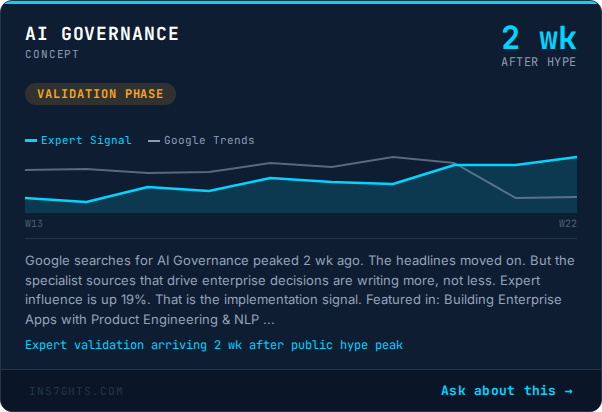
🟢 Signal: Connecting and finding data. The real mover on Friday wasn't a model launch, it was the plumbing that links scattered data together, climbing in genuine influence even as raw chatter dipped. Neo4j's acquisition, Supabase's valuation, and a survey showing only 29% can find their own data all point at the same layer. Most coverage is still grading models while buyers quietly moved their money and their worry to the data underneath.
🔴 Noise: ”Agentic AI” and generic ”AI.” The undifferentiated ”AI,” ”agentic AI,” and ”machine learning” labels pulled the heaviest volume again but kept losing real ground as standalone ideas. The story already moved into specifics: whose data the agents run on, who can locate it, and who's liable when it's wrong. Anyone still tracking ”agentic AI” as one big signal is reading from last year's frame.
 From the 190K
We scanned 190,000 articles this week. Here's what no one's talking about:
Neo4j bought a graph-intelligence firm, investors handed Supabase a $10.5 billion valuation for being the backend, and a survey found only 29% of enterprises can locate the data their AI depends on, all in the same 48-hour window.
Each desk reads these as separate beats. The M&A wires cover the Neo4j deal. The venture press writes up Supabase's round. The governance blogs flag the 29% number. Read them on the same morning and the real picture appears: the entire industry quietly admitted, in one window, that the bottleneck moved off the model and onto whether you can even find and connect your own data. For two years the assumption was that a smarter model was the prize. This week the prize became the boring, traceable, connected data layer, the one most companies are confident about and almost none can actually map. The move on Monday is to stop asking ”which model” and start asking ”can we find it, and can we prove where it came from.”
 By The Numbers
-
Supabase reached a $10.5 billion valuation — On a deal sheet that also showed Generalist closing $2 billion. The market is paying premium multiples for the backend infrastructure, not the consumer app on top of it.
-
Tripo AI raised nearly $200 million — To expand generative 3D. The wave that repriced AI music and video has reached objects and worlds, and the value will land on the training data again.
-
Only 29% of enterprises can find the data their AI depends on — Even though 79% are confident they can scale AI without breaking governance. That 50-point gap between confidence and capability is the real risk on the table.
-
China now ships eight of every ten humanoid robots — Globally. The software narrative is American, but the bodies that AI will move through the physical world are overwhelmingly built in one country.
-
Google's open-sourced flood model extends reliable forecasts by six days — In gauged basins, now live on GitHub under Apache 2.0. Open-sourcing the model hands regional forecasters direct control instead of a black box.
-
CCPA fines reach $7,988 per intentional violation — And apply to firms over a $26.6 million revenue threshold. Per-record math turns a data-governance gap into a balance-sheet number fast.
 Deep Dive: The Map Nobody Drew
Let me take you back to the DJ booth, because it explains this week better than any market chart. When I started, I thought the game was owning the rare records. So I dug, I collected, I built crates most DJs would kill for. Then I played a real venue, three hours, a crowd that kept shifting, and learned the brutal truth: it doesn't matter how good your collection is if you can't find the right track in the eight seconds before the energy drops. The collection wasn't the skill. The map of the collection was. This week, the entire AI industry hit that exact lesson.
The Collection Got Cheap
For two years the whole conversation was about who had the best records, the smartest model. This week the money moved past it. Supabase's $10.5 billion valuation is a bet on the backend, not the app. The model is the track everyone can stream now. When the music is available to everyone, owning a copy stops being the edge.
The Map Got Expensive
And as the model got cheap, the map of the data got priceless. Neo4j bought GraphAware because connecting data is the new scarce skill. Then a survey landed the punchline: only 29% of companies can find their own data. They own enormous collections. Almost none have the map.
The Crowd Is Repricing The Index
That's the repricing nobody's naming. The premium is sliding off ”who has the smartest model” and onto ”who can find, connect, and trust their data on demand.” It's the difference between a DJ with a legendary crate and one who knows exactly where every record is at 2 AM. The first is a hoarder. The second runs the room.
What Actually Works
-
Map before you model: If you can't trace how your core data connects, no model will save you. Draw the graph first.
-
Treat findability as the metric: ”Can we locate every dataset feeding this AI in a day?” is a better readiness test than any model benchmark.
-
Make provenance provable: Where the data came from is now a legal control, not a backlog item. Build the lineage before the regulator asks.
-
Verify the output: An AI answer you can't check is a confident guess. Put a rigor step between the model and the decision.
When everyone has the same records, the crate stops being the edge. The crowd doesn't pay for the collection anymore. They pay for the one DJ in the city who can find exactly the right track at exactly the right moment. That's the whole game now, and this week it got expensive.
 What's Coming
Proactive AI Becomes The Next Pitch
Sam Altman is teasing ”proactive AI” that runs in the background, connected to all your company's context, without waiting to be asked. Watch this closely: an AI that acts on your data unprompted is only as safe as your ability to govern what data it can reach. The 29%-can-find-their-data crowd is exactly who shouldn't turn this on first.
AI Goes Open-Source For The Public Good
Google open-sourced its flood-forecasting framework under Apache 2.0, handing regional forecasters direct control of the model. Expect more critical-infrastructure AI to move from black box to open framework, because trust in high-stakes domains now requires showing your work, not just shipping a prediction.
The Rigor Reckoning Hits Enterprise
The mathematicians' warning about unverified AI results is the leading edge of a broader reckoning. Expect 2026 to bring a wave of ”verification layer” tooling as boards realize that AI which produces confident, unchecked conclusions is a liability dressed as productivity.
 For Your Team
Strategic purpose: Monday is the day this week's shift lands on the leadership table. The headlines were about models and valuations. The real story was that the data underneath, findable, connected, traceable, became the scarce and expensive asset. Your edge is refusing to fund another model project before you can answer where its data lives and whether you can find it.
Monday's meeting prompt: ”If we had to produce, by end of day, every dataset feeding our top AI use case, plus proof we're allowed to use it, could we? And if 79% of companies are confident about exactly this while only 29% can actually do it, which number are we?”
The Find-It-First Framework:
-
Map it — For your top AI use case, draw how the core data actually connects. If you can't, that's project one, not the model.
-
Find it — Make ”can we locate every feeding dataset in a day” a standing readiness test, not a one-time audit.
-
Prove it — Capture lineage and rights at the source. Provenance is now the control regulators and acquirers check first.
-
Verify it — Put a human-trusted rigor step between every AI conclusion and any decision you'd act on.
Share-worthy stat: 79% of enterprises are confident they can scale AI without breaking governance. Only 29% can actually find the data those systems run on. That 50-point gap between confidence and competence is the whole AI risk story in two numbers.
Go deeper: Track where AI value and governance are landing in real-time →
 The Track of the Day
”Can you get AI to just be running as an agent in the background all of the time, connected to all my company's context? Don't even put it on me to understand what it can do. Be useful to me.”
— Sam Altman, OpenAI
Today's set closes on the most honest line of the week, and the most dangerous. Everyone wants the AI that just knows, that reaches into everything and quietly does the work. But ”connected to all my company's context” only sounds like magic if you can find that context, trust it, and prove where it came from. For the 71% who can't, ”be useful to me” is one wrong dataset away from ”be a liability to me.” The map comes first. It always did.
We scanned 190,000 articles this week so you don't have to. Data Pains → Business Gains.
Published: June 5, 2026 | Curated by Yves Mulkers @ Ins7ghts
1,300+ articles scanned. 7 stories selected. Our AI distills the noise into signal—in seconds. Get early access →
Know someone who'd find this useful? Share your unique referral link →
Want Your Own AI Intelligence Briefing?
Our platform analyzes 1,000+ sources daily and delivers personalized insights in seconds.
Join the Waitlist →Founding members: Lifetime discount • Priority access • Shape the product