
In partnership with


 So, What Actually Happened?
So, Wednesday's IPO noise had barely cooled when the real signal showed up, and it was not a valuation. It was a refusal. Microsoft told staff to limit Claude Fable 5 over how long Anthropic now keeps their prompts. We scanned 190,000 articles this week so you don't have to. The same day, NEURA Robotics lined up $1.4 billion for physical AI, and OpenAI bolted a measurement partner onto its new advertising business. Underneath it all, a sharp analyst spelled out why your AI gives different answers to the exact same question. Four stories, one nerve: the companies actually deploying this stuff have stopped asking ”how smart is it” and started asking ”can I see inside it, and can I turn it off.”
The Bottom Line: The headlines sold you capability. The week was actually about control, who keeps your data, who can audit the answer, and who owns the off switch.
The IT strategy every team needs for 2026

2026 will redefine IT as a strategic driver of global growth. Automation, AI-driven support, unified platforms, and zero-trust security are becoming standard, especially for distributed teams. This toolkit helps IT and HR leaders assess readiness, define goals, and build a scalable, audit-ready IT strategy for the year ahead. Learn what’s changing and how to prepare.
 The Tracks That Matter
1. Microsoft Pulls Claude Fable 5 Off Its Own Desks
Here is the move nobody expected from the company that helped fund the field. Within hours of Anthropic shipping its most powerful model yet, Claude Fable 5 (the public, guard-railed version of its Mythos engine), Microsoft told its own employees to limit using it. The reason was not quality. It was the fine print.
Anthropic now retains prompts and outputs for 30 days on Mythos-class models for trust and safety, on every platform where they run. Microsoft's lawyers did the math, and they did not like it: the safety feature and the data-exposure risk are the same feature. The very thing that makes Mythos safer to release is the thing that makes it riskier to feed your secrets.
What makes this matter past the Microsoft-versus-Anthropic soap opera is the precedent. This is the most AI-native company on earth deciding that a model's data terms, not its benchmark scores, are the deal-breaker. Anthropic last raised $65 billion at a $965 billion valuation in late May, so this is not a small vendor being pushed around. It is the first big, public signal that ”where do my prompts go” just became a board-level procurement question.
”Under Anthropic's data retention policy for Mythos-class models, prompts submitted and outputs generated are retained for 30 days for trust and safety purposes on every platform where the models are offered.”
— Reuters, on the policy that triggered Microsoft's restriction
Here's what works: Before you roll out any frontier model, read its data-retention clause the way Microsoft just did. Map which teams handle regulated or competitive data, then give them a model whose retention terms you can actually live with. The benchmark is table stakes. The contract is the moat.
2. OpenAI's Ad Business Just Grew a Measurement Layer
Here is the quiet pivot that should worry every marketing budget. OpenAI is rolling out self-serve advertising inside ChatGPT, turning the assistant 900 million people use into ad inventory. On its own, that is a monetization story. What makes it real is the plumbing that showed up beside it: LiveRamp became the first independent ad-tech firm to pipe conversion data into OpenAI's measurement pipeline, and tools to manage ChatGPT ad campaigns are already shipping.
So, why does the measurement part matter more than the ads themselves? Because an ad channel without measurement is a billboard. An ad channel with conversion tracking and third-party verification is a media-buying line item. The moment you can prove a ChatGPT ad drove a sale, ”AI assistant” stops being a product category and becomes a place you spend your performance budget, sitting right next to the incumbents.
The history here rhymes. Search did not become an advertising empire when it got good at answering questions. It became one when it got good at measuring clicks. OpenAI just took the same step, and it took it fast, with the measurement partners lined up before most CMOs even know the inventory exists.
Here's what works: If you run paid acquisition, get a test budget into conversational ad inventory now, while it is underpriced and uncrowded. The early movers on every new channel (search in 2003, social in 2012) bought attention at a discount that never came back. Treat ChatGPT ads as that window, open today.
Try It Yourself
Your best prompts are the ones you'd never bother typing.

The detailed ones. The ones with examples and edge cases. Wispr Flow lets you speak them instead — clean, structured, ready to paste into any AI tool. Free on Mac, Windows, and iPhone.
3. Physical AI Just Had Its Money Moment
Here is where the capital quietly changed lanes. NEURA Robotics moved to raise up to $1.4 billion in a Series C aimed squarely at physical AI, robots that learn to act in the real world rather than chat about it. That is one of Europe's largest robotics rounds, and it did not come from a hype cycle. It came from investors deciding the next layer of AI value is wearing a body.
It was not alone. The same window saw Nvidia's Jensen Huang announce an AI factory with LG, built to train and validate the GR00T robot foundation model, with LG standing up a ”physical AI data factory” to feed it real-world training data. Put the two together and a pattern snaps into focus: a billion-plus in fresh capital on one side, and the chip-and-model supply chain to spend it on the other. The robots finally have both a budget and a backbone.
I have seen this shape before, in music. For twenty years the money chased the recording, the software, the file. Then everyone remembered that people pay more to watch the live band sweat on stage than to stream the track. AI is having that moment. The screen was the studio. Physical AI is the live show, and this week the promoters started writing the big checks for the tour.
Here's what works: If your business touches atoms (manufacturing, logistics, energy, healthcare), start scouting physical-AI pilots now, not in two years. The funding just told you where the capability curve is heading. The companies that run early warehouse and inspection pilots will own the training data, and the data is the part competitors cannot buy late.
4. dbt Hands the Data Stack Governed AI Agents
Here is the story your data team will actually feel on Monday. dbt shipped a pair of AI agents for governed data work: dbt Wizard, which runs the full build-test-ship lifecycle grounded in your project's lineage, tests, and contracts, and dbt Copilot, the inline assistant that generates SQL, docs, and tests on one click. The word doing the heavy lifting is ”governed.” These agents are wired to the metadata that says what the data means and whether it is allowed to be used that way.
This is the unsexy half of the AI story, and it is the half that decides whether the rest works. We also watched Databricks turn solar and wind PDF reports into structured data with agents this week, and the same lesson sits under both: an AI agent let loose on a data stack with no lineage, no tests, and no contracts is a very fast way to produce confident garbage. Ground it in governance metadata and it becomes a junior engineer who actually reads the docs.
So, here is the real shift. For two years the AI conversation was about the model. Now it is moving down a floor, into the boring, load-bearing layer where data gets defined, tested, and trusted. That is exactly the layer that decides whether an agent's answer is reliable, and it is where the durable enterprise value is going to live.
Here's what works: Before you let any AI agent touch your data stack, check that your lineage, tests, and contracts actually exist and are current. The agent is only as trustworthy as the metadata it stands on. Fund the governance layer first. It is the difference between an agent that ships and an agent that quietly corrupts a quarter of reporting.
Learn AI in 5 minutes a day

You don't have to scroll every AI thread, track every new tool, or watch every demo.
The Rundown AI breaks it all down for you — the latest AI news, tools, and tutorials in one free 5-minute email every morning.
Trusted by 2M+ professionals at Apple, Google, and NASA.
5. Your AI Gives a Different Answer Every Time
Here is the contrarian truth the demos hide. A sharp analyst laid out why AI workflows return different answers to the identical question on different runs, and why that is not a bug you can simply patch out. Same prompt, same data, two runs, two answers. For a chatbot, that is a quirk. For a workflow that approves a loan, flags a transaction, or files a report, it is a compliance time bomb.
So, what is actually happening under the hood? These systems are probabilistic by design. They sample, they vary, they ”improvise.” That is wonderful when you want a creative draft and terrifying when you want the same number twice. The piece's real contribution is naming the fix: you do not make the model deterministic, you wrap it in a deterministic system, with fixed seeds, cached decisions, and hard validation gates around the soft creative core.
This connects to a pattern we keep seeing. Microsoft worrying about where its prompts go, and an enterprise worrying whether its AI gives a repeatable answer, are the same worry wearing two coats. Both are the realization that you cannot govern what you cannot pin down. A system that answers differently every time is, in audit terms, a system with no memory of its own decisions.
Here's what works: For any AI in a regulated or high-stakes workflow, demand reproducibility before accuracy. Pin the inputs, log every decision with its seed, and put validation gates around the model so the same case always yields the same outcome. Save the improvisation for the draft, never for the verdict.
6. Backdoors Are Hiding in the AI Supply Chain
Here is the threat almost nobody is pricing in. Fresh research went down the rabbit hole of AI supply-chain backdoors, the pre-trained models, datasets, and dependencies your team pulls from public hubs without a second thought. The finding is uncomfortable: a poisoned model can behave perfectly in every test you run and still carry a hidden trigger that flips its behavior on one specific input. You cannot test your way out of a backdoor you do not know to look for.
This lands right as the governance crowd wakes up. A widely-shared CISO piece argued what agentic AI governance must control now, and the overlap is the point: the moment you give an AI agent the power to act, every poisoned dependency in its supply chain becomes an action, not just an answer. We spent a decade learning to scan open-source code for tampering. The AI supply chain is the same problem with worse visibility, because a model's weights do not read like source you can review.
So, the so-what for your stack. Most teams treat a downloaded model the way they once treated a random npm package: trust first, ask questions never. That worked until it spectacularly did not. The same reckoning is coming for model provenance, and the firms that get ahead of it will be the ones who can prove where every model in production came from.
Here's what works: Start a model bill of materials now. For every model, dataset, and dependency in production, record where it came from, who trained it, and when you last verified it. Treat unverified model weights like unverified code: quarantined until proven, never trusted by default.
7. The World Cup Is Big Tech's AI Proving Ground
Here is the one that sounds like sports and is actually strategy. With the tournament on, Lenovo and Google turned the World Cup into a high-stakes showcase for their AI, because nothing sells enterprise capability like billions of people watching your system work in real time. The pitch is not the ads. It is the infrastructure: real-time translation, crowd analytics, and generative experiences running flawlessly at a scale no sales deck can fake.
So, why stage it at a football match? Because a live global event is the most brutal demo environment there is. There is no ”let me reset the server.” If the AI stutters, the whole world sees it stutter. Pulling it off in front of that crowd is a credibility play aimed straight at the CIOs deciding whose cloud and whose models they will bet on next year.
It is the oldest trick in the book, dressed in new tech. Companies have always used the biggest stage to prove they belong on it. The World Cup is just this year's coliseum, and the gladiators are running inference instead of swords.
Here's what works: When you evaluate an AI vendor, ask where they run at peak load, not where they demo at rest. The vendors comfortable performing live, under unforgiving real-world conditions, are the ones whose reliability claims you can trust. Stress is the only honest benchmark.
 Signal vs. Noise
🟢 Signal: AI agents moving from talk to deployment. While the cameras chased model launches, AI agents quietly climbed in real influence even as their raw mention count cooled, the tell that enterprises stopped debating them and started wiring them in. dbt's governed agents and Databricks turning field reports into structured data are the proof: agents are now plumbing, not panels. Most coverage still treats ”AI agents” as a buzzword instead of a budget line.
🔴 Noise: The Anthropic launch-and-IPO buzz. Anthropic pulled some of the heaviest mention volume on the wires this week off its model launch and IPO race, but its pull across the rest of the AI conversation actually slipped day over day. A model release and a public filing are events, not capability shifts. Anyone trading the buzz as a Monday-morning change is reading the press cycle, not the product.
 From the 190K
We scanned 190,000 articles this week. Here's what no one's talking about:
Microsoft restricted its own staff from a top model over data retention, fresh research exposed hidden backdoors in the AI supply chain, and an analyst showed enterprise AI cannot give the same answer twice, all in one 48-hour window.
Each desk files these apart. The tech-business beat covers the Microsoft-Anthropic friction. The security press writes up the supply-chain backdoors. The analytics crowd debates AI reproducibility. Read them on the same morning and one story emerges: the companies actually running AI in production have stopped asking how powerful it is and started demanding to see inside it, where the data goes, where the model came from, and whether the answer holds up twice. Trust just stopped being a feeling and became a checklist.
The move on Monday is to run that checklist on your own stack. For every AI system in production, can you say where the prompts are stored, where the model originated, and whether it returns a reproducible answer? If any one of those is a shrug, that is your most urgent AI project this quarter.
 By The Numbers
-
Anthropic raised $65 billion at a $965 billion valuation in late May, weeks before shipping Claude Fable 5. The model launches keep getting bigger, and so do the war chests behind them.
-
NEURA Robotics moved to raise up to $1.4 billion in a Series C for physical AI, one of Europe's largest robotics rounds. The capital that chased chatbots is rotating toward robots.
-
ISO 27001 can cut cyber-insurance premiums by up to 22% for European businesses, while the certification market grows 11.5% a year through 2030. Governance is becoming a line item with a measurable payback.
-
The industry has shipped 312-plus tracked AI model releases this year, a release pace no enterprise procurement process was built to absorb. The bottleneck is no longer models. It is governing them.
-
Anthropic retains prompts and outputs for 30 days on its Mythos-class models, the exact policy that made Microsoft limit internal use. The fine print is now the headline.
 Deep Dive: The Money Left the Screen
Let me take you back to a club in 2009, because that is where I learned this lesson the expensive way. For years the smart money in music was all digital: the download store, the streaming app, the file you could copy a million times for free. Everyone was so busy chasing the software that they forgot the one thing you cannot pirate, a sweaty room full of people who paid to be there. The money did not disappear. It walked out of the laptop and onto the stage. This week, AI had the exact same moment.
The Studio Got Crowded
For three years, AI value lived on a screen. Chatbots, copilots, models that write and summarize and draw. It was a gold rush into bits, and like every gold rush, it got crowded and the margins got thin. When 312-plus models ship in a single year, ”we have a smart model” stops being a business. The studio is full, and everyone in it sounds the same.
The Band Walked On Stage
Then the capital moved. NEURA Robotics lining up $1.4 billion for physical AI is not a software round, it is a bet on machines that act in the physical world. Nvidia and LG standing up an AI factory for the GR00T robot model is the supply chain to build them at scale. Robots are expensive, slow, and hard, which is exactly why they are defensible. You cannot copy a warehouse full of trained machines the way you copy a model weight.
The Encore Is Data
Here is the part the headlines miss. The robots are not the moat. The data they generate by moving through the real world is. Every pick, every inspection, every failed grip becomes training data nobody else has, the physical equivalent of a live recording you can only make by actually playing the show. The first movers will own a dataset their competitors physically cannot download.
What Actually Works
- Follow the capital, not the demo: A billion-dollar round signals where the capability curve bends next. Physical AI just got its signal.
- Find your atoms: Map where your business touches the physical world (logistics, inspection, energy, care) and pilot there first.
- Hoard the real-world data: The training data from early physical pilots is the asset competitors cannot buy late. Start generating it now.
- Stop overpaying for pure software smarts: When hundreds of models a year all sound alike, the durable edge is in the layer that is hard to copy, not the one that is easy.
The set just changed, and the crowd has not noticed yet. Everyone is still staring at the screen where the software plays, while the real money quietly bought tickets to the live show. The band is tuning up. You can keep streaming the old track, or you can get to the venue before the doors close.
 What's Coming
Physical AI's Funding Wave Is Just Starting
NEURA's $1.4 billion round is the opening note, not the finale. Expect a run of nine-figure physical-AI and humanoid rounds through the rest of 2026 as the capital that flowed into language models hunts for a harder-to-copy moat. Watch for robot foundation models to become the new model-launch arms race.
”Where Does My Data Go” Becomes a Procurement Clause
After Microsoft limited Claude Fable 5 over retention terms, expect data-retention and deletion guarantees to move from legal fine print to the first page of enterprise AI contracts. The vendors who publish clear, short retention terms will win deals the benchmark leaders lose.
AI Advertising Turns Into a Measured Channel
With OpenAI wiring measurement into ChatGPT ads, expect conversational ad inventory to get its own analytics dashboards and verification standards by year-end. The first CMOs to test it will buy attention at a discount that closes fast, the way search and social did before it.
 For Your Team
Strategic purpose: Friday is the day this week's shift lands on the leadership table. The headlines were about IPOs, model launches, and billion-dollar valuations. The real story was that the companies running AI in production stopped asking ”how smart is it” and started asking ”can I trust it, and can I turn it off.” Your edge is refusing to treat AI control as the legal team's problem when it just became strategy.
Friday's meeting prompt: ”For every AI system we run in production, can we say exactly where our data goes, where the model came from, and whether it gives the same answer twice? If we can't, which one do we fix first?”
The Control Test Framework:
- Know where the data goes — Read every model's data-retention terms before deployment. If you cannot live with the retention window, you cannot use the model, no matter how well it scores.
- Know where the model came from — Keep a model bill of materials. Every model, dataset, and dependency in production needs a verified origin, or it is a backdoor waiting to trigger.
- Demand a repeatable answer — For any high-stakes workflow, require reproducibility before accuracy. Pin inputs, log decisions, and gate the model so the same case always lands the same way.
- Write the off switch — For every critical AI system, document how you would disable or swap it. A system you cannot turn off is a system you do not control.
Share-worthy stat: Microsoft, one of the most AI-native companies on earth, restricted its own employees from a frontier model not over quality but over a 30-day data-retention policy. When the people who build AI say no to AI on data terms, ”where do my prompts go” just became a board-level question.
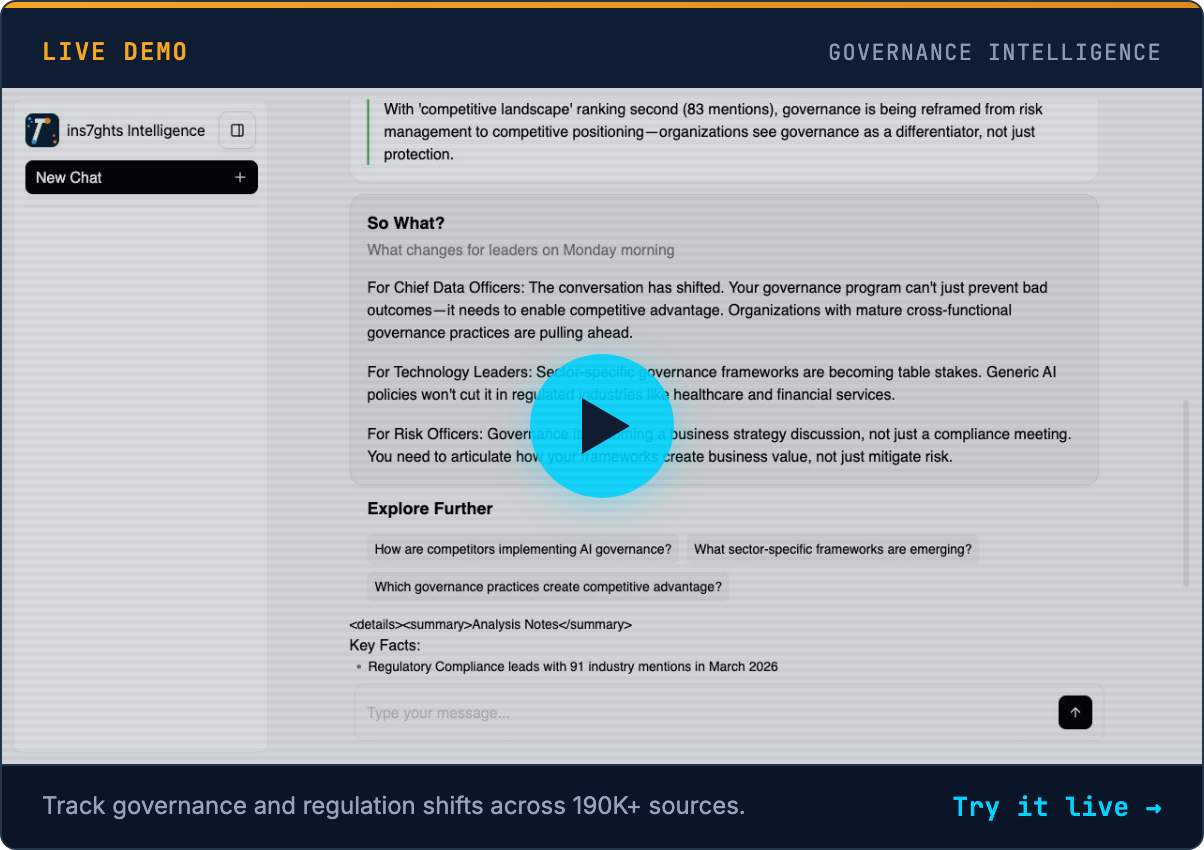
Go deeper: Track where AI control and capital are moving in real time →
 The Track of the Day
”Most analytics investments stall not because the platform is wrong, but because nobody built the system that connects the data to the decisions.”
— From a data-consulting field note this week
That line is not about AI, and that is exactly why it is the truest thing I read this week. Swap ”analytics” for ”AI” and it still holds. Microsoft is not limiting Claude because the model is bad. NEURA is not raising $1.4 billion because robots are clever. The whole week was about the unglamorous system around the smart thing: who holds the data, who can audit the answer, who owns the off switch. The model is the track. The system that lets you trust it is the set. Anyone can drop a great track. Building a set people dance to all night, that is the job.
We scanned 190,000 articles this week so you don't have to. Data Pains → Business Gains.
Published: June 11, 2026 | Curated by Yves Mulkers @ Ins7ghts
1,300+ articles scanned. 7 stories selected. Our AI distills the noise into signal—in seconds. Get early access →
Know someone who'd find this useful? Share your unique referral link →
Want Your Own AI Intelligence Briefing?
Our platform analyzes 1,000+ sources daily and delivers personalized insights in seconds.
Join the Waitlist →Founding members: Lifetime discount • Priority access • Shape the product