
In partnership with


 So, What Actually Happened?
So, the headlines spent the day gawking at the next model, and the real money quietly moved to the layers around it. We scanned 190,000 articles this week so you don't have to, and the same story kept surfacing under different bylines. China's DeepSeek banked $7.4 billion at a $50 billion-plus valuation, proving a cheap, open model can raise like a frontier lab. Databricks bought security firm Panther to bolt threat detection onto the data platform. Visa wired real payments into ChatGPT, so an agent can now actually spend your money. And underneath the noise, one number kept repeating: most enterprise AI projects are still on track to be abandoned because the data was never ready. Build the smartest model you want. It still trips over your plumbing.
The Bottom Line: The model just became a commodity you can price-shop. The one thing you cannot buy off the shelf is data your AI can actually trust.
Your prompts are leaving out 80% of what you're thinking.

When you type a prompt, you summarize. When you speak one, you explain. Wispr Flow captures your full reasoning — constraints, edge cases, examples, tone — and turns it into clean, structured text you paste into ChatGPT, Claude, or any AI tool. The difference shows up immediately. More context in, fewer follow-ups out.
89% of messages sent with zero edits. Used by teams at OpenAI, Vercel, and Clay. Try Wispr Flow free — works on Mac, Windows, and iPhone.
 The Tracks That Matter
1. DeepSeek Banks $7.4B as the Cheap-Model Threat Gets a War Chest
The company that scared every frontier lab last year just got rich. DeepSeek closed its first outside funding round, pulling in over 50 billion yuan (about $7.4 billion) at a valuation north of $50 billion, with Tencent and battery giant CATL among the backers. This is the lab that built competitive open-weight models on a fraction of the budget American labs burn. Now it has a war chest to match the ambition.
What makes this more than another mega-round is the leverage it hands buyers. The reporting that surfaced it framed the $7 billion opportunity as proof that DeepSeek still sets the price floor for the whole AI market. Even Western incumbents are reportedly weighing a self-hosted DeepSeek to trim their own model bills. When the cheapest credible model in the room is also one of the best funded, the ”you must pay frontier prices for frontier quality” pitch starts to wobble.
So why care if you are not shopping for a model in Shenzhen? Because your model vendor just got a credible price competitor with deep pockets and open weights. The frontier model is sliding from a scarce asset toward a commodity you negotiate on, and that changes every renewal conversation you are about to have. The smart move is to treat your model layer like compute or storage: assume it gets cheaper and more swappable every quarter.
Here's what works: Put a real open-weight option (DeepSeek-class) into your next model evaluation, even if you never deploy it. Pricing a credible alternative is how you stop overpaying for a layer that is rapidly commoditizing. Use it as leverage at renewal.
2. Databricks Buys Its Way Into Security With Panther
Here is build-versus-buy answered in a press release. Databricks struck a deal to acquire Panther Labs, the startup behind an AI platform for detecting cyberattacks, folding security straight into the data and AI stack. Databricks could have built threat detection on its own lakehouse. Instead it wrote a check, because the data platform that holds your most sensitive information is now expected to defend it too.
The framing in the company's own announcement is the tell. Databricks pitched the deal as further establishing its security posture, not as a side bet, signaling that data platforms and security platforms are collapsing into one purchase. A separate read on the move noted Databricks is acquiring the cyberattack-detection startup precisely as enterprises pour proprietary data into AI pipelines that did not exist to defend two years ago. The lakehouse just grew a security guard.
So the so-what for your roadmap is that the line between ”where my data lives” and ”who protects my data” is disappearing. As AI agents reach deeper into production systems, the platform vendors are racing to own detection before a breach makes it their problem too. For buyers, that means fewer point tools to stitch together, but also more lock-in to the platform that now sees both your data and your threats.
Here's what works: Map which of your AI pipelines feed sensitive data into a platform that cannot yet see an attack on them. Where your data platform and your detection are separate vendors, ask both how they integrate before the next incident forces the question. Consolidation here is coming whether you plan for it or not.
Try It Yourself
Hiring in 8 countries shouldn't require 8 different processes

This guide from Deel breaks down how to build one global hiring system. You’ll learn about assessment frameworks that scale, how to do headcount planning across regions, and even intake processes that work everywhere. As HR pros know, hiring in one country is hard enough. So let this free global hiring guide give you the tools you need to avoid global hiring headaches.
3. Visa Puts Real Money Behind AI Agents at Checkout
The agent just got a wallet. Visa integrated its secure global payments directly into ChatGPT, letting an AI assistant complete a real transaction instead of just recommending one. For two years the demo stopped at ”here is what you should buy.” This wires in the part where the agent actually buys it, with a payments network most of the planet already trusts standing behind the charge.
This is the unglamorous rail that makes agentic commerce real. Everyone has been selling agents that can shop; almost nobody solved how an agent pays without handing a chatbot your raw card number. Visa's bet is that the missing piece was never smarter recommendations, it was a trusted settlement layer with fraud controls and dispute rights baked in. The same insight runs through this whole week: the model was the easy part, the infrastructure around it is the hard part.
So the strategic read is that ”agentic commerce” just stopped being a slide and got a payment rail. Once an assistant can complete a purchase end to end, the battle moves to who owns the checkout moment, the merchant, the model, or the network that clears the money. If you sell anything online, an agent-mediated path to your product is no longer hypothetical, and the businesses that make themselves easy for agents to transact with will quietly win the next wave.
Here's what works: Ask one question in your next commerce review: when an AI agent tries to buy from us on a customer's behalf, what happens? If the answer is ”it breaks,” you have a roadmap item. The companies that are legible to agents (clean product data, clear pricing, a working payment path) get bought from first.
4. Your AI Keeps Failing, and the Model Was Never the Problem
Here is the line every vendor skips. As one sharp piece on AI-readiness put it, most enterprises are building AI on data that was never prepared for it, and that is the single biggest reason projects stall before they ever reach production. Not the model. Not the GPUs. The plumbing. More than 60% of AI projects are on track to miss their business targets and get quietly abandoned by the end of 2026, and almost all of them will blame the wrong thing.
The data backs the gloom. The same analysis cites Gartner finding that over 75% of organizations now rank AI-ready data among their top five investment priorities, which is a polite way of admitting most of them are not there yet. A separate study found APAC organisations risking their AI ROI precisely because they raced to models before fixing foundations. And the trap is sneaky: AI-ready data is not ”high quality” in the abstract, it is data prepared for one specific use case, with the lineage and access controls a production model depends on.
So this is the contrarian note in a week obsessed with model price tags. Everyone is shopping for a cheaper, smarter model while the thing that actually decides success sits untouched in their warehouses. Your model is now a commodity you can swap in an afternoon. Your data is the part nobody else has, and the part nobody wants to do the unglamorous work on. Garbage in, garbage out did not retire when the models got bigger. It got louder.
Here's what works: Before funding another model pilot, pick one stalled AI project and audit its data, not its algorithm. Trace lineage, find the silos, check whether governance ever accounted for the detail AI needs. Fixing the data is slower and less exciting than swapping models, and it is the only move that actually moves your success rate.
Learn AI in 5 minutes a day

You don't have to scroll every AI thread, track every new tool, or watch every demo.
The Rundown AI breaks it all down for you — the latest AI news, tools, and tutorials in one free 5-minute email every morning.
Trusted by 2M+ professionals at Apple, Google, and NASA.
5. Chronograph Lands $140M to Run the Data Under Private Capital
While everyone watched the model rounds, a quieter data play closed. Chronograph landed more than $140 million in growth equity from Sixth Street Growth, betting that private-equity and venture investors will pay handsomely for clean, connected data on their own portfolios. Not a flashy chatbot. The unsexy infrastructure that tells a fund what it actually owns and how those holdings are really performing.
This is a tell about where durable value is forming. Public markets have decades of standardized data; private markets run on spreadsheets, PDFs, and quarterly guesswork. Chronograph's pitch is that the bottleneck in private capital was never the analysis, it was getting trustworthy data into one place to analyze at all. It is the same lesson as the data-readiness story one track up, just aimed at a $13 trillion asset class that has been flying on instruments it half-trusts.
So why does a portfolio-monitoring raise matter to your strategy? Because it marks the pattern of the week in miniature: the money is moving to whoever organizes the messy data underneath an industry, not to whoever bolts an AI on top of it. The defensible businesses being funded right now are the ones turning chaos into something queryable. That is true in private equity, and it is true in your company.
Here's what works: Look at your most important decisions and ask where the data still lives in spreadsheets and inboxes. That gap is exactly what Chronograph monetized for investors. The function in your business running on PDFs and quarterly guesswork is your highest-return data project, long before it is an AI project.
6. The UN Hands AI a Power Bill It Can't Ignore
The cost of the AI boom finally got an official invoice. A United Nations report warned of the environmental cost of data centers, putting hard numbers on the energy and water the AI buildout quietly consumes. For two years the industry treated power and cooling as someone else's problem. A UN-level warning means the externality just became a policy question, and policy questions become compliance line items.
This lands the same week the build-out got physical. The companies wiring power and cooling under AI data centers are racing to add capacity, and now a global body is asking what that capacity costs the grid and the water table. Put the two together and a pattern emerges: the scarce resource in AI was never just chips, it is megawatts, water, and increasingly, permission. The sustainability desk and the AI desk are about to be the same meeting.
So the contrarian read is that your AI strategy now has a regulatory weather front you did not forecast. As scrutiny of data-center footprints rises, expect reporting requirements, siting fights, and energy costs to flow downstream into what cloud AI actually costs you. The teams that treat AI's physical footprint as a future compliance obligation, not a press-release talking point, will not get blindsided when the rules arrive.
Here's what works: Add an energy-and-emissions line to your AI vendor questions. Ask where your workloads physically run, what that grid and water footprint looks like, and whether the provider can report it. The sustainability cost of AI is becoming a disclosure requirement, and the buyers asking now will not be scrambling when it is mandatory.
 Signal vs. Noise
🟢 Signal: Data security as the gate on AI rollouts. Databricks just paid for a security company, and data security is climbing in real influence even as raw mention volume cools, a sign the audit and security teams (not the model teams) are now deciding which AI projects ship. Most coverage is still chasing model launches and missing that buying authority quietly moved to whoever protects the data.
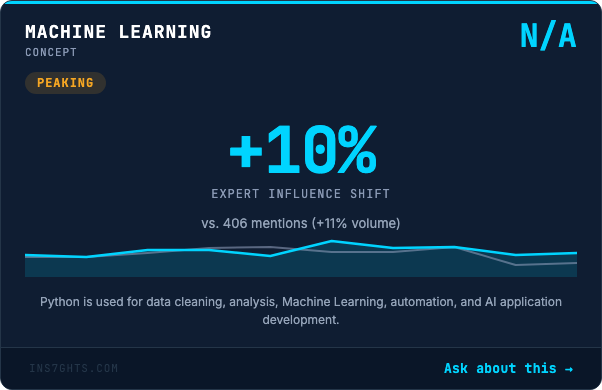
🔴 Noise: ”Agentic AI” and ”Machine Learning” as catch-all labels. Both pulled heavy mention volume again while their real pull across the conversation slipped. The undifferentiated buzzwords are loud, but the fundable work moved one layer down, into security M&A, payment rails, and data readiness. Anyone tracking ”agentic AI” as a single signal is reading the conference brochure, not where the budget actually went.
 From the 190K
We scanned 190,000 articles this week. Here's what no one's talking about:
DeepSeek raised $7.4 billion at a fraction of US-lab valuations, Western incumbents are reportedly weighing a self-hosted DeepSeek to cut their model bills, and OpenAI pushed GPT-5.6 out the door in under 60 days.
Read separately, each desk files these as routine. The funding wire covers the DeepSeek round. The enterprise-IT press notes the cost-cutting chatter. The model-watchers clock another fast point release. Read them on one morning and a different picture emerges: the frontier model just became a price-shopped, swappable commodity, with release cycles measured in weeks and credible open-weight options undercutting the premium labs. The ”one or two expensive models you build your whole stack on” assumption that shaped AI procurement for two years is dissolving. The move on Monday is to stop treating your model choice as a marriage and start treating it as a supplier you re-bid, because the thing that actually differentiates you is no longer the model. It is the data only you have.
 By The Numbers
-
DeepSeek raised about $7.4 billion at a $50 billion-plus valuation — China's open-weight challenger now has frontier-lab money behind frontier-class models, setting the price floor for the whole market.
-
Chronograph landed more than $140 million in growth equity — from Sixth Street Growth, to run the data infrastructure under private-equity and venture portfolios. The money is in organizing the mess, not bolting AI on top.
-
Over 75% of organizations rank AI-ready data a top-five priority — per Gartner, even as more than 60% of AI projects are on track to be abandoned for missing business targets by the end of 2026.
-
Only 19% of core HR processes apply generative AI at scale — with a further 32% still in pilot, per McKinsey. The gap between ”piloting AI” and ”running AI in production” is where most of the value is still stuck.
-
Wave Ventures closed a €10M fund for Nordic founders — a reminder that while the mega-rounds grab headlines, early-stage European capital keeps quietly seeding the next layer.
 Deep Dive: The Model Was Never the Bottleneck. Your Data Was.
When I was DJing, I learned a brutal lesson early. You can own the best decks in the building, the Pioneer setup everyone drools over, and still clear the dancefloor in ten minutes. Because the gear was never the act. The act was the crate: months of digging, every record cleaned, labeled, and sorted so I could find the right track in the dark at exactly the right moment. Hand me perfect decks and a crate of warped, mislabeled vinyl, and I am dead on stage. This week, the entire AI industry walked into that booth, and most of them are still polishing the decks.
The commodity nobody wants to admit
The model is becoming the decks: expensive-looking, increasingly interchangeable. DeepSeek just raised $7.4 billion to keep undercutting the premium labs on price, incumbents are weighing self-hosted open models to cut costs, and point releases now ship in under 60 days. When the best gear in the room is cheap and swappable, owning it stops being an advantage. Everybody has good decks now.
The bill nobody budgeted for
Here is the part that hurts. More than 60% of enterprise AI projects are heading for the scrap heap, and the post-mortems will blame the model. They will be wrong. Most of those projects were built on data that was never prepared, never lineaged, never governed for the detail AI demands. Over 75% of organizations now call AI-ready data a top priority, which is a confession dressed as a survey result. They bought the decks before they sorted the crate.
The work nobody demos
Nobody films the boring part: the mise en place, the prep before you cook, the cleaning and labeling of every record. Data lineage, access controls, killing the silos, making decisions traceable. It is unglamorous, it is slow, and it is the only thing that reliably separates an AI project that ships from one that quietly dies in pilot. The vendors will not sell it to you because there is no logo to show. You have to do it yourself.
What Actually Works
- Treat the model as a supplier, not a soulmate: Assume it gets cheaper and swappable. Re-bid it. Never build your moat on a layer that commoditizes every quarter.
- Audit data before algorithms: For every stalled project, trace the data, not the model. The failure is almost always upstream of the AI.
- Fund the unsexy prep: Lineage, governance, and de-siloing are the mise en place. No demo, highest return.
- Buy your moat where nobody else can shop: Your proprietary, well-organized data is the one asset a competitor cannot purchase off the shelf. Invest there.
The decks keep getting better and cheaper, and that is exactly why they stopped being the act. The crowd only dances if the crate is clean. Sort your records before you blame the gear.
 What's Coming
Humanoids Step Onto the Factory Floor
Genesis AI unveiled its minimalist Eno humanoid this week, and it will not be the last. Physical AI is moving from research demos toward the warehouse and the assembly line. Watch which manufacturers pair these bodies with real data pipelines, because a humanoid is only as smart as the systems feeding it, the same data-readiness gap, now with arms.
The Network Starts Driving Itself
HPE expanded its self-driving networking strategy as AI moves into production infrastructure. The next frontier of automation is not the chatbot, it is the plumbing running itself: networks that detect, route, and heal without a human in the loop. Expect ”autonomous operations” to creep from marketing slides into real ops budgets by year-end.
The US AI Rulebook Splinters by State
Colorado moved to refine rather than retreat from its AI regulation while new state privacy laws keep multiplying. With no federal standard, compliance is becoming a fifty-state patchwork. The companies that build jurisdiction-awareness into their AI now will not be rebuilding it in a panic when the next state line goes live.
 For Your Team
Strategic purpose: Thursday is when this week's shift should hit the leadership table. The headlines were about which model is cheapest or smartest. The real story was that the model became a commodity, and the differentiator moved to the data, the security, and the rails around it. Your edge is making that pivot on purpose, before your competitors stop overpaying for the wrong layer.
Thursday's meeting prompt: ”If our main AI model got 50% cheaper from a competitor tomorrow, what would actually change for us, and what wouldn't? And if the answer is 'not much changes,' what does that tell us about where our real advantage has to come from?”
The Commodity-or-Moat AI Audit:
- Sort every AI layer into commodity or moat — Model, compute, and tooling are commodities you should price-shop. Your data and your workflows are the moat. Fund them differently.
- Re-bid the commodities — If you have not pressure-tested your model vendor's price against an open-weight alternative this quarter, you are likely overpaying for a layer that is collapsing in cost.
- Audit the moat for readiness — Pick your highest-value data asset and check whether it is actually AI-ready: lineaged, governed, de-siloed. Most are not.
- Name the owner — Every commodity layer needs a procurement owner; every moat asset needs a product owner. If the data has no owner, it is no one's moat.
Share-worthy stat: More than 60% of enterprise AI projects are on track to be abandoned by the end of 2026, and the cause is rarely the model. It is data that was never prepared for it. The bottleneck moved, but the budgets have not.
Go deeper: Track where AI's real money is moving →
 The Track of the Day
”Most enterprises are building AI on data that was never prepared for it, and it's the single biggest reason AI projects stall before reaching production.”
— from this week's data-readiness analysis
Whatever model you pick, cheap or premium, open or closed, you are pouring it on top of your data. And you cannot build a sovereign anything on a foundation you do not trust. The decks got cheaper this week. The crate is still where the set lives or dies. Sort your records.
We scanned 190,000 articles this week so you don't have to. Data Pains → Business Gains.
Published: June 17, 2026 | Curated by Yves Mulkers @ Ins7ghts
1,300+ articles scanned. 7 stories selected. Our AI distills the noise into signal—in seconds. Get early access →
Know someone who'd find this useful? Share your unique referral link →
Want Your Own AI Intelligence Briefing?
Our platform analyzes 1,000+ sources daily and delivers personalized insights in seconds.
Join the Waitlist →Founding members: Lifetime discount • Priority access • Shape the product