
In partnership with


 So, What Actually Happened?
So, the labs kept shipping models this week, and the smart money quietly walked right past them to buy the floor underneath. Cyera raised $600 million at a $12 billion valuation to lock down the data that AI feeds on. We scanned 190,000 articles this week so you don't have to. In the same window, Jeff Bezos's Prometheus pulled in $12 billion for science-grade AI, an analyst spelled out how agentic BI quietly breaks when it runs on ungoverned numbers, and Europe moved to stand up sovereign AI for defense. Four stories, one nerve. Nobody is paying a premium for a smarter chatbot anymore. They are paying for the boring, secured, governed layer that the smart thing has to stand on, and this week they paid a lot for it.
The Bottom Line: The headlines sold you intelligence. The week was actually about the foundation, who secures your data, who governs the answer, and who owns the ground the model stands on.
Your prompts are leaving out 80% of what you're thinking.

When you type a prompt, you summarize. When you speak one, you explain. Wispr Flow captures your full reasoning — constraints, edge cases, examples, tone — and turns it into clean, structured text you paste into ChatGPT, Claude, or any AI tool. The difference shows up immediately. More context in, fewer follow-ups out.
89% of messages sent with zero edits. Used by teams at OpenAI, Vercel, and Clay. Try Wispr Flow free — works on Mac, Windows, and iPhone.
 The Tracks That Matter
1. Cyera Banks $600M to Guard the Data AI Runs On
Here is the deal that tells you where the bottleneck moved. Cyera raised $600 million at a $12 billion valuation, and the reason is unglamorous on purpose: every model an enterprise turns on is only as safe as the data it can reach. Cyera's whole job is to find, classify, and fence off sensitive data before an AI agent wanders into it and copies it somewhere it should never be.
So, why does a data-security company hit a $12 billion price tag in the same week the frontier labs are bragging about benchmarks? Because the buyers have figured out the order of operations. The model is the easy part now, you can rent one. The hard, expensive, board-level part is letting that model near your customer records, your contracts, and your regulated data without springing a leak. Cyera is selling the seatbelt for a car everyone already bought.
This is the quiet inversion of the AI budget. A year ago the line item was ”buy a smarter model.” Now the binding constraint is ”can I prove the smart thing cannot exfiltrate what it touches,” and that is a data-security problem, not a model problem. When the safety layer commands a higher multiple than most model startups, the market is telling you exactly which side of the stack is scarce.
Here's what works: Before you greenlight your next AI agent, map the sensitive data it can reach and ask who classifies and gates it. If the answer is ”the model is supposed to be careful,” you do not have a control, you have a hope. Fund the data-security layer first, then let the agent in.
2. Bezos Bets $12 Billion That Science Beats Chat
Here is the round that makes the chatbot wars look small. Jeff Bezos's Prometheus raised $12 billion at a $41 billion valuation, and in a rare sit-down with Bajaj, the pitch was not another assistant. It was AI aimed at the physical sciences, manufacturing, and engineering, the messy real-world problems where being wrong is expensive and a confident paragraph is not an answer.
So, read the size of this against the rest of the week. A data-security firm raised $600 million and felt huge. Bezos raised twenty times that for one company before it has a public product. When capital concentrates like that around ”AI for science” instead of ”AI for text,” it is a bet that the next decade of value is in machines that help discover materials and design hardware, not machines that draft your emails faster.
The history here rhymes with how every gold rush matures. The first wave sells the flashy consumer thing because it is easy to demo. The durable money shows up later, when the technology gets pointed at the unsexy, capital-heavy industries that actually move GDP. Bezos skipping the chatbot stage entirely is a signal about where he thinks the floor of real value sits, and he has been right about a few infrastructure bets before.
Here's what works: If you run R&D, manufacturing, or any atoms-heavy business, stop benchmarking AI on how well it writes and start testing it on how well it reasons over your physical processes. The capital just voted that science-grade AI is the next frontier. The companies that pilot it against real engineering problems now will own the workflow data nobody can buy later.
Try It Yourself
The IT strategy every team needs for 2026

2026 will redefine IT as a strategic driver of global growth. Automation, AI-driven support, unified platforms, and zero-trust security are becoming standard, especially for distributed teams. This toolkit helps IT and HR leaders assess readiness, define goals, and build a scalable, audit-ready IT strategy for the year ahead. Learn what’s changing and how to prepare.
3. Agentic BI Looks Magic Until the Numbers Drift
Here is the contrarian truth your dashboard vendor will not lead with. A sharp analysis laid out how agentic BI actually breaks once you move it past a demo: the agent does not just answer a question, it pursues a goal across many steps, and along the way it can invent metrics, drift away from the right query, spawn near-duplicate dashboards, and quietly bypass permissions. Same question, different run, different number, and no human in the loop to catch it.
So, what is really going on under the hood? The same lesson keeps surfacing across the data stack this week. Snowflake is pitching a context layer as the missing link for enterprise AI, and a working analytics engineer publicly reversed his position on semantic layers. All three point at the same wall: an AI agent let loose on raw tables with no governed definitions is a very fast way to produce confident garbage.
”The governed infrastructure layer underneath the agent is where the production complexity lives, and it is largely absent from current vendor and category coverage.”
— from this week's agentic BI teardown
The so-what for your data team is sharp. For two years the AI conversation lived in the model. It just moved down a floor, into the boring layer where a metric is defined once, tested, and trusted. That layer decides whether your agent's answer is reproducible or improvised, and it is exactly the part nobody put on the roadmap.
Here's what works: Before you let an AI agent touch your BI stack, check that you have a governed metrics layer, definitions in code, auditable access policies, and row-level security. If ”revenue” can mean three things depending on which table the agent grabbed, the agent will confidently pick the wrong one. Govern the numbers first, then automate the questions.
4. Europe Wires Sovereign AI Into Its Defense Stack
Here is the story that is really about who owns the ground. GFT and INTEC partnered to accelerate sovereign AI for European defense modernization, and the operative word is ”sovereign.” The point is not a smarter model. The point is AI that runs on infrastructure a government controls, with data that never leaves its jurisdiction, for a sector where ”whose cloud is this running on” is a national-security question, not a procurement footnote.
So, why does this matter past the defense beat? Because government just became one of the biggest AI buyers in the room, and it is buying on different terms than the enterprise. In the United States, every HHS agency increased its AI use cases in fiscal 2025, with most still in pre-deployment. Defense in Europe, health agencies in the US, same pattern: the public sector is adopting fast, but only where it can prove control over where the model and the data physically live.
That is a tell for everyone, not just the public sector. The most demanding buyers on earth are drawing the line at sovereignty and control, and private enterprises with regulated data are about two quarters behind them. ”Where does this run and who can see it” is becoming the first question, not the last.
Here's what works: If you sell into regulated industries or government, sovereignty is now a feature you can lose deals over. Map which of your AI workloads can run inside a customer-controlled boundary, and be able to answer ”where does the data live” before they ask. If you are the buyer, write that question into the RFP now, while vendors still treat it as optional.
Learn AI in 5 minutes a day

You don't have to scroll every AI thread, track every new tool, or watch every demo.
The Rundown AI breaks it all down for you — the latest AI news, tools, and tutorials in one free 5-minute email every morning.
Trusted by 2M+ professionals at Apple, Google, and NASA.
5. ZincFive's $752M Bet on the Power Under AI
Here is the layer of the AI stack that runs on electrons, not tokens. AI power provider ZincFive lined up a $752 million SPAC deal to go public, betting that the backup-power and battery layer under AI data centers is its own investable category now. Everyone talks about chips. Almost nobody talks about the fact that a data center full of those chips is useless the second the power hiccups.
So, the timing is not an accident. The same week, ASHRAE, NEMA, and PNNL released an AI data-center performance framework aimed squarely at energy efficiency, because the power and cooling bill is becoming the constraint that decides whether an AI buildout pencils out. When the standards bodies and the capital markets move on the same layer in the same week, that layer just graduated from plumbing to strategy.
This is the part of the AI story that is hard to copy, which is exactly why it is defensible. You can rent a model in an afternoon. You cannot conjure a megawatt of reliable, efficient backup power, and you cannot pour a data center's worth of it overnight. The companies that own the power layer are selling the one thing in AI that physics will not let you fake.
Here's what works: If your AI roadmap depends on compute you do not own, ask your providers the unglamorous question, what is your power and cooling headroom, and what happens at peak. The vendors who can answer with real numbers are the ones whose capacity promises you can actually bank on. Reliability, not raw flops, is where the next bottleneck bites.
6. Zhipu Reframes the AI Race as Who Gets to Interpret
Here is the one that sounds philosophical and is actually strategic. Chinese AI lab Zhipu launched what it frames as a battle for the right to interpret the digital world, and the framing is the news. While Western labs measure the race in valuations and benchmark points, Zhipu is describing it as a contest over whose model sets the default lens, whose worldview gets baked into the system that millions of people will ask to explain reality back to them.
So, why pay attention to a framing rather than a product? Because framing is how you spot a strategy before it ships. An AI assistant is not a neutral pipe. Whoever's model becomes the default interpreter of news, markets, and history quietly sets the defaults for what ”normal” looks like, and that is a soft-power position no benchmark captures. Zhipu saying the quiet part out loud tells you China's labs are competing on interpretive control, not just capability.
This is the contrarian read most Western coverage misses while it tallies funding rounds. The AI race was never only about who has the smartest model. It is increasingly about whose model becomes the lens a billion people see through, and that is a fight over influence, not just market share.
Here's what works: When you evaluate AI tools, do not only ask how capable they are. Ask whose defaults and whose worldview they carry, because that is what you inherit when you standardize on one. For anything customer-facing or judgment-heavy, knowing the model's built-in lens is now part of due diligence, not a philosophy seminar.
7. Capsa AI Raises $18M to Read Private Markets for You
Here is the discovery that should make a few analysts sit up. Capsa AI secured $18 million to expand a private-capital intelligence platform, AI built to read the messy, scattered, un-Googleable data of private markets and turn it into something a dealmaker can act on. Public markets have had Bloomberg terminals for decades. Private capital has had a junior analyst, a spreadsheet, and a lot of late nights.
So, what is actually being automated here is the grunt work that used to define the entry-level seat. Pulling together fragmented filings, cap tables, and signals across thousands of private companies is exactly the kind of high-effort, low-glamour synthesis that AI eats first. The bet is that the edge in private markets shifts from ”who has the relationships” toward ”who can see the whole board fastest,” and that the seeing can be bought for $18 million of engineering.
For anyone in deal flow, that is both a tool and a warning. The tool gives a small fund the research muscle of a much bigger one. The warning is that the analyst work which used to take a week becomes a query, and the roles built around doing that work by hand are the ones that get rethought first.
Here's what works: If your team does diligence or market mapping by hand, run a pilot against an AI intelligence layer this quarter and measure the time delta, not the vibe. If it turns a week into an afternoon, the question stops being ”should we use this” and becomes ”what does the freed-up week get spent on.” Reallocate the judgment, automate the gathering.
 Signal vs. Noise
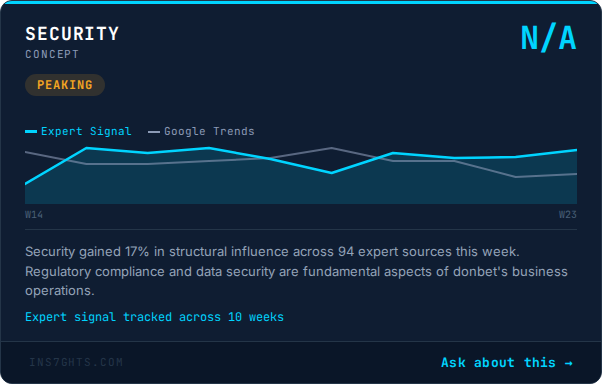
🟢 Signal: The data-security and quality layer. Data security and data quality are climbing in real influence this week, and the proof is in the checkbook, Cyera's $600 million round landed exactly as enterprises realized the constraint on AI is not model smarts, it is whether they can let a model near their data safely. Most coverage is still scoreboard-watching the model launches and missing that the money moved one floor down.
🔴 Noise: ”Agentic AI” as a label. Agentic AI pulled heavy mention volume again across the wires, but its real pull across the conversation actually slipped day over day. Everyone is saying ”agents,” few are funding the governed layer that makes agents safe to deploy. Anyone trading the buzzword as a Monday-morning change is reading the press cycle, not the production reality.
 From the 190K
We scanned 190,000 articles this week. Here's what no one's talking about:
Cyera raised $600 million to secure enterprise data, an analyst exposed how agentic BI breaks on ungoverned numbers, and Europe stood up sovereign AI for defense, all in the same 48-hour window the headline labs were shipping more models.
Each desk files these apart. The funding press covers the Cyera round. The data-engineering crowd debates governed metrics. The defense beat writes up sovereign AI. Read them on the same morning and one story emerges: the spend and the trust both moved beneath the model, into the layer where data gets secured, defined, and kept inside a boundary you control. The ”just buy a smarter model” assumption that drove two years of AI budgets just hit its limit, the model is now the cheap part, and the foundation under it is where the scarce, defensible, expensive work lives.
The move on Monday is to audit your own stack one floor below the model. For every AI system you run, can you name who secures the data it touches, who governs the numbers it returns, and whose ground it runs on? If any one of those is a shrug, that gap is more urgent than your next model upgrade.
 By The Numbers
-
Cyera raised $600 million at a $12 billion valuation as AI data-security demand surged. The seatbelt for AI now costs more than most of the cars.
-
Bezos's Prometheus raised $12 billion at a $41 billion valuation for science-grade AI, before shipping a public product. The capital is rotating from AI-for-text toward AI-for-physics.
-
AI power provider ZincFive lined up a $752 million SPAC to go public. The power-and-cooling layer under AI is now its own public-market story.
-
Over 80% of the code Anthropic ships is now written by its own AI, with the average engineer shipping 8 times the code they did in 2024. The job is shifting from writing to judging.
-
Capsa AI raised $18 million to give private-market dealmakers the kind of intelligence layer public markets have had for decades. The analyst's grunt work just became a query.
 Deep Dive: The Floor Got Expensive
Let me tell you about the part of a building nobody photographs. When I walk past a glass tower, my eye goes straight to the top, the penthouse, the logo, the view. But I spent enough years around construction to know the truth: the money and the danger both live underground, in the foundation and the load-bearing walls. You don't build a skyscraper on sand. And this week, in AI, somebody finally started pouring serious concrete.
The Tower Everyone Photographs
For two years, the entire AI conversation has been about the top of the building. Whose model is smartest, whose benchmark is highest, whose chatbot writes the cleanest paragraph. The launches kept coming, and we kept staring up. It made for great headlines and a crowded penthouse where every model started to sound like the one next door. The view is lovely. It is also not what holds the building up.
The Concrete Got Poured This Week
Then watch where the capital actually went. Cyera raised $600 million to secure the data, ZincFive lined up $752 million for the power, Europe wired sovereign AI into defense, and an analyst made the case that agentic BI dies without a governed metrics layer. None of that is the penthouse. All of it is the foundation, the security, the power, the governed numbers, the ground you control. The smart money quietly bought the floor while everyone else photographed the roof.
What Cracks When You Skip It
Here is why this is not optional. An AI agent on ungoverned data invents metrics and drifts. A model on unsecured data leaks. A workload on infrastructure you don't control is a sovereignty risk waiting to surface. Skip the foundation and the building looks fine right up until the day it leans, and by then the crack is in the load-bearing wall, not the wallpaper. The boring layer is boring right up until it is the only thing that matters.
What Actually Works
- Fund the foundation before the finish: Secure the data and govern the numbers before you buy a smarter model. The model is the cheap, rentable part now.
- Find your load-bearing walls: Map which AI workloads carry regulated or competitive data, and pour the security and governance there first.
- Own the ground where it counts: For sensitive workloads, sovereignty and control are now features. Know where the model and data physically live.
- Test the answer twice: If your AI gives a different number on two runs, you have a roadmap problem, not a quirk. Governed definitions are the fix.
Everyone is still pointing their camera at the top of the tower, admiring the view. The crews who win the next decade are the ones underground, pouring the concrete nobody claps for. The penthouse is gorgeous. But you sleep in the building because of the foundation, and this week the foundation got expensive for a reason.
 What's Coming
AI Data Security Becomes an M&A Magnet
Cyera's $600 million round is the opening bid, not the finale. Expect a run of nine-figure rounds and acquisitions across AI data security through the rest of 2026, as every enterprise realizes its agents are only as safe as the data layer underneath them. Watch the big platforms move to buy this capability rather than build it.
Sovereignty Moves From Fine Print to First Page
After GFT and INTEC wired sovereign AI into European defense, expect ”where does this run and who can see it” to climb to the top of enterprise AI contracts, not just government ones. The vendors who can prove customer-controlled boundaries will win deals the pure capability leaders lose.
Agentic BI Governance Becomes Its Own Category
With analysts now naming exactly how agentic BI breaks, expect ”governed metrics layer” to turn from an engineering footnote into a product category by year-end. The first data teams to wrap their agents in governed definitions will trust their dashboards again while everyone else debugs hallucinated numbers.
 For Your Team
Strategic purpose: Monday is when this week's shift lands on the leadership table. The headlines were about model launches and mega-valuations. The real story was that the spend and the risk both moved beneath the model, into the data, the security, the power, and the governed numbers. Your edge is refusing to treat the foundation as someone else's problem when it just became the strategy.
Monday's meeting prompt: ”For every AI system we run, can we name who secures the data it touches, who governs the numbers it returns, and whose infrastructure it runs on? Which one of those is a shrug right now, and why is that not our most urgent project?”
The Foundation Audit Framework:
- Secure the data layer — Know who finds, classifies, and gates the sensitive data your AI can reach. ”The model is careful” is a hope, not a control.
- Govern the numbers — Require a governed metrics layer with definitions in code before any agent touches your BI. If a metric means three things, the agent picks the wrong one.
- Own the ground — For regulated or competitive workloads, know where the model and data physically live. Sovereignty is now a feature you can lose deals over.
- Demand reproducibility — If an AI returns a different answer on two runs of the same question, that is a foundation crack, not a quirk. Fix it before you scale it.
Share-worthy stat: Over 80% of the code one frontier AI lab now ships is written by its own AI, and the average engineer ships eight times the code they did in 2024. When the people building AI hand most of the keyboard to AI, ”what does the human do” stops being theoretical and becomes a workforce-planning question.
Go deeper: Track where AI's money and risk are really moving →
 The Track of the Day
”The governed infrastructure layer underneath the agent is where the production complexity lives, and it is largely absent from current vendor and category coverage.”
— from this week's agentic BI teardown
That line is not about a product. It is the whole week in one sentence. Cyera did not raise $600 million because data security is exciting. Bezos did not raise $12 billion because robots are clever. The whole week was about the unglamorous layer under the smart thing, the data, the governance, the power, the ground. The model is the track everyone hears. The governed system that lets you trust it is the rig, the wiring, and the power running the whole night. Anyone can drop a great track. Building the rig that lets the set run clean until close, that is the actual job.
We scanned 190,000 articles this week so you don't have to. Data Pains → Business Gains.
Published: June 12, 2026 | Curated by Yves Mulkers @ Ins7ghts
1,300+ articles scanned. 7 stories selected. Our AI distills the noise into signal—in seconds. Get early access →
Know someone who'd find this useful? Share your unique referral link →
Want Your Own AI Intelligence Briefing?
Our platform analyzes 1,000+ sources daily and delivers personalized insights in seconds.
Join the Waitlist →Founding members: Lifetime discount • Priority access • Shape the product