
In partnership with


 So, What Actually Happened?
So, Wednesday morning, and the whole week the smart money quietly stopped paying for the model and started paying for the people who can make it work. We scanned 190,000 articles this week so you don't have to. Anthropic and Blackstone bought an implementation firm instead of another lab, Sonar acquired Gitar to police the code AI now writes by the truckload, and a benchmark of long-horizon work showed the best AI agent flunking two of every three tasks. Meanwhile state lawmakers pushed a fresh AI crackdown the same week Colorado was busy gutting its own.
The Bottom Line: The model layer is commoditizing in plain sight, and value is rushing to the unglamorous layer next door, the judgment to rebuild real systems, the discipline to verify the output, and the governance to keep it legal. Everyone bought the same record this week. The mixing is where the money went.
Private Credit Belongs in the Fixed-Income Sleeve. Against Those Benchmarks, the Numbers Aren't Close.

For the trailing twelve months ending March 31, 2026:† ·
Percent ABS: 14.6% net returns after losses
High-yield bonds: 8.9%
Leveraged loans: 6.1%
Investment-grade bonds: 4.5%
Private credit isn't an equity substitute. It belongs in the fixed-income sleeve — and against bond benchmarks, the performance gap is hard to dismiss. A collateralized loan with a fixed coupon and a defined repayment schedule fills the same portfolio role as a bond, with different terms and a different risk profile.
What you access on Percent:†
17.0% current weighted average coupon rate
93.5% of performing deals pay monthly fixed-rate coupons
Deal terms 6–24 months
Full borrower documentation before you commit a dollar
Starting at $500 $2B+ total issuance. 1,000+ deals. 60,000+ accredited investors. 0.44% lifetime net loss rate on asset-based deals.
Alternative investments are speculative. No assurance can be given that investors will receive a return of their capital. †Past performance is not indicative of future results. Benchmark indices shown for market context only and are not directly comparable to Percent's performance. Terms apply.
 The Tracks That Matter
1. Anthropic And Blackstone Bought The Layer Models Can't Replace
Here's the deal that tells you where this is heading. A consortium led by Anthropic, Blackstone, and Hellman & Friedman acquired Fractional AI, a two-year-old applied-engineering startup, to build a category-defining AI services firm. Not a model. Not a chip. A firm whose entire job is rewiring businesses around models that already exist.
The backer list is the tell. The broader venture pulls in Goldman Sachs, General Atlantic, Apollo, GIC, and Sequoia, the kind of money that does not chase the next demo. Blackstone's operating chief was blunt about why: they have spent years studying where AI creates durable value, and the answer ”hinges on execution capability, the caliber of the team, the depth of their technical judgment.” Translation, the frontier model is the easy part now. The hard part is the human who can redesign a P&L around it.
This is the same wall I've watched companies hit for fifteen years, finally getting priced correctly. For two years the story was ”buy the best model and win.” This week the people with the most information bet the opposite: that the model is table stakes and the implementation is the moat. When private equity starts buying engineering judgment as an asset class, the era of model-as-differentiator is closing.
Here's what works: Stop benchmarking vendors on whose model scores highest. Start asking who actually rebuilds your workflow around it, and whether that judgment lives in-house or in a contract. The model you can rent in an afternoon. The team that can rewire your operations around it is the thing the smart money just paid up for.
2. Sonar Buys Gitar To Police The Code AI Writes
While the headlines chased models, a quieter acquisition named the hangover. Sonar, the code-quality company, bought Gitar to bolt AI code review onto its verification platform. The pitch is simple and a little grim: AI is now writing so much code, so fast, that you need AI to check it before it ships.
The reason this matters showed up in the same corpus. Enterprise engineering teams are reporting that AI-generated code drives a sharp decline in code reuse and a spike in duplicated code, the kind of mess that quietly makes every future change harder. And the vibe-coding boom has turned anyone with a prompt into a web-app builder, while leaving the teams who inherit that code badly exposed. Generate fast, regret slowly.
So we've arrived at the predictable place. The first wave of AI coding sold speed. The second wave is selling the cleanup, the verification layer that catches what the generator got wrong before it reaches production. Sonar buying its way into that layer is a bet that the bill for ”ship faster” is now large enough to be its own market.
Here's what works: If your developers are shipping AI-generated code, put a verification gate between the generator and main, today. Treat AI output like a fast junior who never sleeps and never double-checks: useful, but nothing it writes reaches production without an automated reviewer and a named human on the merge.
Try It Yourself
What does that $70k hire really cost?

Salary is only part of the equation. Local taxes, benefits, and employment costs add up quickly.
Use Oyster’s calculator to estimate the real cost of hiring globally, in seconds.
3. State Lawmakers Push An AI Crackdown Colorado Just Walked Back
Here's the regulatory whiplash, and it's getting sharper. The same week Colorado was busy gutting its own AI Act, state lawmakers elsewhere pushed a fresh compliance crackdown, tightening rules on automated decisions, disclosure, and accountability. One statehouse loosens, another bolts the door. There is no national direction, only fifty negotiations.
For anyone running AI across state lines, that's the real story, and it isn't ”will there be regulation.” It's ”which patchwork applies to which customer.” A model that's compliant in one state can be a liability two borders over, and the rules are now moving in opposite directions within the same quarter. Planning your AI strategy around ”what will the law be” is planning around a coin that keeps landing on its edge.
The deeper shift is who carries the risk. As the statutory floor fragments, the obligation slides into contracts and into your own governance, the documentation, the human-review steps, the audit trail you can produce when a regulator in any one jurisdiction comes asking. Compliance stops being a box you check once and becomes a posture you maintain across a moving map.
Here's what works: Map your AI deployments to the states your customers actually live in, then build to the strictest one, not the friendliest. A single compliance posture tuned to the toughest jurisdiction is cheaper than fifty bespoke ones, and it's the only version that survives a rulebook changing direction mid-year.
4. The Best AI Agent Still Flunks Two Of Three Real Jobs
Of all the numbers this week, this is the one to tape to your monitor. On APEX-Agents, a benchmark built to test AI on long-horizon professional work that needs sustained planning and execution, Google's Gemini 3.1 Pro leads with 33.5%, trailed by Kimi K2.6 at 27.9%. The best agent on the board completes roughly one real multi-step job in three.
That gap between the demo and the desk is the whole conversation. These same models look magical in a thirty-second clip. Put them on the kind of sustained, messy, multi-step task an actual analyst does all day, and two-thirds of the time they don't finish it correctly. The benchmark isn't measuring trivia, it's measuring whether the thing can hold a plan together across a real workflow. Mostly, it can't yet.
Read this next to the Fractional AI deal and it clicks. The reason judgment and implementation are suddenly worth billions is precisely because the agents can't run unsupervised. A tool that succeeds one time in three is not an employee, it's a power tool, and power tools need an operator who knows when the cut is going wrong. The valuations are pricing the operator, not the tool.
Here's what works: Before you deploy an agent on anything that matters, ask the vendor for its long-horizon completion rate, not its single-shot demo. If the honest answer is ”about one in three,” design the workflow so a human owns the other two, with checkpoints the agent can't skip. Autonomy is a roadmap, not a feature you have today.
Done-For-You TikTok Shop Scaling
Zainith Agency is a boutique marketing agency focused exclusively on TikTok Shop.
They’ve helped brands like Momofuku, Obvi, First Day, and Ice Shaker scale TikTok Shop to $15M+ in sales last Q4.
Generate $1M+ yearly revenue for your eCom brand? Claim your free audit below.
5. A New Job Title Appeared Because The Model Wasn't Enough
Here's the discovery the labor desk is underplaying. A credential market is forming around the forward deployed engineer, the person who sits between the AI platform and the business and actually makes the thing deliver value on site. It's a job that barely existed two years ago, and it's now coalescing into a recognized, certifiable role.
That's not a curiosity, it's a signal about where the work is moving. The traditional boundaries are already blurring: software engineers are acting as product managers, product owners are shipping code, and the most valuable person on the team is increasingly the one who can translate ”we have Claude” into ”here's the workflow it rebuilt.” The model is the instrument. The forward deployed engineer is the one who can actually play it in front of a paying crowd.
For your hiring plan, the implication is direct. The scarce, expensive talent of 2026 isn't the person who can train a model, it's the person who can deploy one into a live business and make it stick. Job titles are reorganizing around implementation faster than the org chart can keep up, and the companies that name and reward that role first will pull the people who make AI pay.
Here's what works: Look at your AI initiatives and find the person already doing the forward-deployed job without the title, the one translating platform capability into shipped outcomes. Name the role, pay for it, and build a bench. The bottleneck on your AI roadmap isn't model access, it's the handful of people who can land it.
6. Your Employees Already Pasted Company Secrets Into A Chatbot
Here's the security story hiding in plain sight. Bring-your-own-AI and shadow AI inside HR and the wider org have quietly become a standing data-leak risk, employees pasting sensitive records into consumer chatbots because the sanctioned tools are slower or don't exist. The convenience is real. So is the exposure.
The shape of the fix is showing up too. One enterprise rolled out a governed generative-AI platform to 3,400 users in 21 days specifically to eliminate shadow AI and keep sensitive data inside the perimeter, the corporate equivalent of giving everyone a safe, sanctioned tool before they improvise an unsafe one. Because that's the trap: data risk management now demands a data-centric security model, not a policy memo nobody reads. You don't stop shadow AI by banning it. You stop it by making the safe path the easy path.
This generalizes well past HR. Any team where the official AI tooling lags what's free on the open web has already built a quiet pipeline of confidential data flowing out the side door. The faster you've dragged your feet on sanctioned tools, the more of these you've got, unmapped and unmonitored.
Here's what works: Run one honest survey: which AI tools are your people actually using, and what are they pasting into them? Then close the gap by shipping a governed alternative faster than you write the ban. A policy that forbids shadow AI without offering a real replacement just teaches people to hide it.
7. Core42 Raised $550M To Build What Everyone Else Rents
While apps fought for attention, the infrastructure money kept moving down the stack. Core42 raised $550 million to scale AI infrastructure, a nine-figure bet on the compute and capacity layer that every flashy AI app quietly depends on. No chatbot, no consumer launch. Just the wiring underneath.
It fits the week's pattern. The capital that isn't buying implementation judgment is buying the physical foundation, the data-center capacity, the financing structures, the unsexy plumbing that turns a model into a service that stays up. These are the bets that don't make a keynote but decide who can actually serve AI at scale when the demand lands.
The strategic read for buyers is about dependency. The more your AI strategy leans on rented capacity from a thin layer of providers, the more your run-rate and your uptime live in someone else's hands. The firms raising at this layer are positioning to be that someone. Worth knowing who, before the renewal.
Here's what works: Map every AI workload to the infrastructure it actually runs on, and count your suppliers per layer. Where you've got exactly one, you've got a single point of both failure and price. The companies raising hundreds of millions to build capacity are betting you'll need a second option. Line one up before you need it.
 Signal vs. Noise
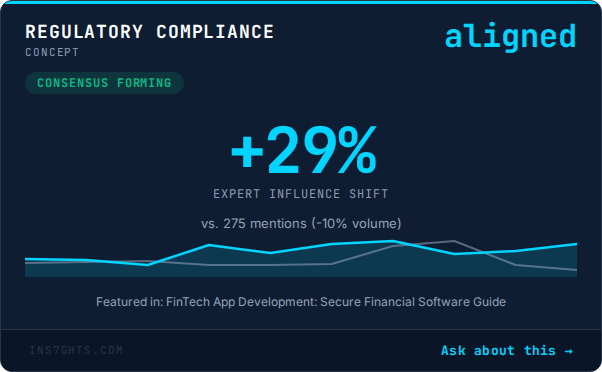
🟢 Signal: Compliance and governance ownership. The compliance-and-governance layer kept gaining real influence this week while the marquee model names slipped, the clearest sign yet that the people who sign off on AI risk are now setting the agenda. State lawmakers tightening rules and private equity buying implementation firms to deploy AI ”the governed way” are where the authority actually moved. Most coverage is still keyword-screening for model launches and missing it.
🔴 Noise: The ”Machine Learning” and generic ”AI” labels. The catch-all ”AI” and ”machine learning” tags pulled the heaviest mentions again this week but lost ground in real influence, lots of volume, less substance underneath. Anyone tracking the story by the buzzword is missing the actual movement, which is in the unglamorous implementation, verification, and governance plumbing that decides whether any of it reaches production.
 From the 190K
We scanned 190,000 articles this week. Here's what no one's talking about:
A private-equity consortium bought an AI implementation firm, a new ”forward deployed engineer” credential market took shape, and a code-quality company acquired its way into AI code review, all in the same week a benchmark showed the best AI agent finishing only one real task in three.
Each desk reads these alone. The M&A desk covers the Fractional acquisition. The labor desk notices the new job title. The engineering desk writes up Sonar buying Gitar. The research desk reports the benchmark score. Read them on the same morning and the real picture appears: the value in AI is migrating wholesale from the model to the people and processes around it, because the model still can't be trusted to run unsupervised. The agents flunk two jobs in three, so the money is flowing to whoever can supervise the third, the implementer, the verifier, the governor. The strategic move on Monday is to stop auditing your AI strategy by which model you bought and start auditing it by who, exactly, is accountable for making that model deliver, and verifying that it did.
 By The Numbers
-
Gemini 3.1 Pro leads APEX-Agents at 33.5% — On a benchmark of sustained, multi-step professional work, the best AI agent completes roughly one job in three, and the runner-up, Kimi K2.6, manages 27.9%. The autonomy gap, in one number.
-
Core42 raised $550 million to scale AI infrastructure — A nine-figure round for the compute-and-capacity layer underneath the apps, a reminder that frontier-AI capital is still flowing hard to the unglamorous foundation, not the front-end.
-
More than three-quarters of organizations now use AI in financial planning — AI in planning, reporting, and commercial analysis crossed from edge case to default, which is exactly why advisors who dismiss it are starting to lose the room.
-
Nurses saved 20.6 minutes per 12-hour shift with ambient AI documentation — Across an average 4.5 patients each, automated digital documentation gave clinical staff real time back, a clean example of AI value measured in minutes returned, not features shipped.
-
Global insured catastrophe losses topped $20 billion in Q1 2026 — Running 6% above the 21st-century average, against an estimated $58 billion in total economic losses, the kind of risk-modeling pressure that's pushing insurers hardest toward AI-driven analytics.
 Deep Dive: Everyone Bought The Same Record. The Mixing Is The Job.
Let me take you back to a club, 2 a.m. The thing nobody outside DJing understands is that the records aren't the secret. Anyone can buy the same vinyl I bought. The track everyone wants is in every serious DJ's crate. The difference between a packed floor and an empty one was never the record, it was reading the room, knowing the order, catching the moment to drop it. That's the AI industry this week. Everyone bought the same model. The mixing is where the money went.
The Model Stopped Being The Differentiator
For two years the pitch was ”we have the best model.” This week the people with the most information bet against that frame. A consortium with Blackstone, Hellman & Friedman, and Anthropic money bought an implementation firm, not a lab, and named ”technical judgment” and ”execution capability” as the durable asset. When private equity prices judgment as the thing worth buying, the model has quietly become the commodity, the record anyone can pull from the crate.
Because The Agent Can't Run The Set Alone
The reason judgment is suddenly priceless is sitting in the benchmark. The best agent on APEX-Agents finishes one long-horizon job in three. That's not an employee you leave alone with the decks, it's a brilliant, erratic intern who needs an operator watching the mix. So the work splits: the tool generates, and a human, increasingly a forward deployed engineer, supervises, verifies, and lands it. The same logic put Sonar in the business of checking AI's code.
And The Floor Is Still Wet
Underneath all of it, the boring constraint hasn't moved. Shadow AI is leaking data out the side door, AI-generated code is duplicating itself into a maintenance swamp, and the rulebook is fragmenting state by state. None of that is a model problem. It's an implementation-and-governance problem, the wiring and the sound check, the part the crowd never sees but absolutely hears when it's wrong. The labs solved the easy thing first. The hard thing was always going to be everything around it.
What Actually Works
-
Audit by accountability, not by model. Stop asking ”which model did we buy” and start asking ”who owns making it deliver, and how do we verify they did.”
-
Name the operator. Find the forward-deployed person already translating platform capability into shipped outcomes, give them the title and the budget, build a bench.
-
Put a gate between generation and production. AI output, code or analysis, never reaches prod without an automated verifier and a named human on the merge.
-
Make the safe AI path the easy one. You don't ban shadow AI, you out-compete it with a governed tool people actually want to use.
Anyone can buy the record. This week the smartest money in the room stopped paying for the vinyl and started paying for the hands on the decks. The model is in everyone's crate now. The only question left is whether you've got someone who can read the floor and drop it at the right moment, or whether you're still arguing about which track to buy while the crowd files out.
 What's Coming
AI Services Firms Become An Asset Class
The Fractional AI acquisition is the opening move, not the whole game. Expect a wave of private-equity-backed roll-ups of AI implementation and services firms over the next two quarters, as the money that can't differentiate on models buys the teams that deploy them. Watch who else gets bought, the buyer list tells you where durable value is presumed to sit.
The Compliance Map Keeps Fragmenting
State lawmakers pushing fresh crackdowns while others roll back means the patchwork gets messier before it gets cleaner. Expect ”which jurisdictions does this deployment touch” to become a standing question in AI project reviews, and the companies that built one strict, portable compliance posture to move faster than the ones re-litigating it state by state.
Agent Benchmarks Become Procurement Criteria
Long-horizon benchmarks like APEX-Agents are about to leave the research blog and land in the RFP. As completion rates become the honest measure of whether an agent can actually do a job, expect buyers to start demanding them, and vendors who only show single-shot demos to face a harder room.
 For Your Team
Strategic purpose: Thursday is the day this week's pattern turns into one decision before the next operating review. The week said it plainly: the model is no longer your differentiator, and pretending it is keeps you spending on the wrong layer. Your edge lives in who deploys, who verifies, and who governs, and naming those owners is the work most companies keep skipping.
Thursday's meeting prompt: ”If the best AI agent finishes only one real task in three, and the smartest money just paid billions for implementation instead of models, then who on our team actually owns making AI deliver, and how would we prove it worked? Or are we still shopping for a better model to avoid that question?”
The Implementation Premium Framework:
-
Audit by accountability — For every AI initiative, name the human who owns the outcome and the verification step that proves it landed. No owner, no project.
-
Pay for the operator — Find and reward the forward-deployed person translating platform capability into shipped results. That role, not model access, is your real bottleneck.
-
Gate the output — Put an automated verifier plus a named human between any AI generation and production. Treat one-in-three reliability as the design assumption, not the exception.
-
Out-compete shadow AI — Ship a governed, genuinely usable AI tool faster than you write the policy banning the unsafe one.
Share-worthy stat: The best AI agent on a benchmark of real, long-horizon professional work completes just 33.5% of tasks, roughly one in three, the same week a private-equity consortium paid up to acquire an AI implementation firm rather than a model. Drop that on the next strategy call and the ”should we be buying models or buying the people who deploy them” conversation writes itself.
Go deeper: Track where AI value is actually landing in real time →
 The Track of the Day
”If you don't have measurement, it's a rumor.”
— From a discussion on proving the real cost and value of enterprise AI
Today's set closes on the record every data person already owns but too few play: the measurement track. The whole week was a scramble to figure out where AI value actually lives, and the honest answer is you cannot know until you measure it, the completion rate of the agent, the time the tool actually saves, the data leaking out the side door, the code duplicating in the dark. The operator running on vibes and vendor demos is mixing blind. The one who walks into Thursday with a number for every AI claim, who owns it, what it delivered, how we checked, is the one whose set actually lands.
Yves Mulkers, your data DJ, mixing 190,000 articles into the tracks that actually matter.
We scanned 190,000 articles this week so you don't have to. Data Pains → Business Gains.
Published: May 27, 2026 | Curated by Yves Mulkers @ Ins7ghts
1,300+ articles scanned. 7 stories selected. Our AI distills the noise into signal—in seconds. Get early access →
Know someone who'd find this useful? Share your unique referral link →
Want Your Own AI Intelligence Briefing?
Our platform analyzes 1,000+ sources daily and delivers personalized insights in seconds.
Join the Waitlist →Founding members: Lifetime discount • Priority access • Shape the product