

 So, What Actually Happened?
So, Tuesday, and the money just walked right past the model and went straight to the wiring. AMD committed £2 billion to building AI capacity in Britain, while SK Telecom and Nvidia started wiring Korea its own national AI grid. We scanned 190,000 articles this week so you don't have to. Meanwhile AlphaSense hit a $7.5 billion valuation selling AI that reads the market for you, and somewhere quieter, hackers turned Meta's own AI into a lock pick for 20,000 Instagram accounts.
The Bottom Line: The headlines chased the next chatbot, but the capital, the contracts, and the lawyers all moved one floor down, to the chips, the data plumbing, and the rules. The model was never the moat. The foundation is.

AI experimentation made sense when the costs were low. At scale, that same approach gets expensive fast.
The engineering leaders managing this well made deliberate decisions about where AI investment earns its keep. Find out what works on June 15.
 The Tracks That Matter
1. AMD Bets £2 Billion That Britain Builds Its Own AI
Here's the number that tells you where the smart money is pointing. AMD said it would commit up to £2 billion to accelerate AI innovation in the UK, a multi-year bet on silicon, talent, and compute capacity planted firmly on British soil. This isn't a press-release partnership. It's a chipmaker buying a seat at the table of a country that decided it doesn't want to rent its intelligence from someone else's data center.
The strategic tell is geography. For two years, ”AI strategy” meant picking which American hyperscaler to send your workloads to. Now governments are treating compute the way they treat power and water, infrastructure too important to fully outsource. Read AMD's UK move next to Korea wiring its own grid, and a pattern shows up: the question shifted from ”which cloud” to ”whose soil.”
For enterprise buyers, sovereign compute stops being a policy abstraction and becomes a procurement clause. Where your AI workloads physically run, who controls that capacity, and whether your government has a domestic option are about to matter for data residency, resilience, and price.
Here's what works: Add a ”where does this physically run” line to every AI vendor review this year. Sovereign and regional compute options are multiplying fast, and the buyer who maps them now has leverage the buyer who assumed ”the cloud” doesn't.
2. AlphaSense Hits $7.5 Billion Selling AI That Reads The Market
Here's a valuation that should make every analyst sit up. AlphaSense raised $350 million at a $7.5 billion valuation, and the number underneath it is the one that matters: it crossed $600 million in annual recurring revenue, up from $500 million just eight months earlier. That's not hype money. That's a business people pay real subscriptions for.
What are they paying for? AI that digests the market intelligence a human team would take 40 hours a week to read, and hands back the signal. The backers tell the story, Accenture Ventures, J.P. Morgan Asset Management, and D. E. Shaw Ventures aren't tourists, they're the exact buyers who live or die on knowing something before the competitor does. When the people who trade on information start buying the machine that reads it, the category is real.
The deeper signal is what enterprises now treat as core spend. Two years ago, ”AI for research” was a nice-to-have demo. A $600 million revenue run-rate says it's become infrastructure, the layer between the firehose of information and the decision someone makes on Monday.
Here's what works: Audit where your team still pays humans to read and summarize, market reports, competitor moves, regulatory filings. That's exactly the work synthetic research is now eating at scale. Pilot it on one recurring report before the budget conversation finds you first.
Try It Yourself
The IT strategy every team needs for 2026

2026 will redefine IT as a strategic driver of global growth. Automation, AI-driven support, unified platforms, and zero-trust security are becoming standard, especially for distributed teams. This toolkit helps IT and HR leaders assess readiness, define goals, and build a scalable, audit-ready IT strategy for the year ahead. Learn what’s changing and how to prepare.
3. SK Telecom And Nvidia Wire Korea Its Own AI Grid
Here's the move that rhymes with AMD's. SK Telecom and Nvidia announced they're building AI infrastructure to power Korea's national AI ambitions, a telco and a chipmaker teaming up to stand up domestic compute rather than route it through somewhere else. South Korea has been blunt that AI infrastructure is now a top national R&D priority, and this is what that priority looks like in steel and silicon.
Put it beside AMD's £2 billion in Britain and the picture sharpens. Within the same 48 hours, two countries on two continents both took concrete steps to build sovereign AI capacity. The era when ”the cloud” meant three American companies is getting its first real second-supplier references, one country at a time.
The reason this matters past the geopolitics: a telco owns the thing the hyperscalers don't, the physical network and the local trust. When the company that already runs the country's connectivity also runs its AI compute, the bundle gets very hard to dislodge. That's not a product launch. That's positioning for a decade.
Here's what works: If you operate in Asia or Europe, ask your AI providers what regional and sovereign infrastructure they can actually deliver, not what they plan to. The vendors building local capacity now are the ones who'll clear data-residency and resilience requirements you'll be handed in a future contract.
4. Hackers Turned Meta's Own AI Into A Lock Pick
Here's the security story nobody wants on the demo stage. Attackers stole more than 20,000 Instagram accounts by turning the platform's own AI features against its users, a reminder that the same capability that helps you write a caption can help someone else craft a flawless phishing lure at industrial scale. The tool didn't get hacked. It got used exactly as designed, just by the wrong hands.
This isn't an isolated scare. European businesses have started securing their AI agents as a distinct line of cybersecurity spend, because an autonomous agent with access to your systems is a new kind of attack surface, one that can be talked into doing things a firewall never imagined. The spending shift says the threat moved from theory to budget.
For data and security leaders, the lesson generalizes. Every AI capability you deploy to make life easier for your people makes life easier for an attacker too, unless you've governed it. The convenience and the vulnerability are the same feature seen from two sides.
Here's what works: Treat every AI agent you deploy like a new employee with system access, scope its permissions, log what it does, and assume it can be socially engineered. The companies writing ”AI agent security” into the budget now are the ones who won't be writing the breach disclosure later.
Learn AI in 5 minutes a day

You don't have to scroll every AI thread, track every new tool, or watch every demo.
The Rundown AI breaks it all down for you — the latest AI news, tools, and tutorials in one free 5-minute email every morning.
Trusted by 2M+ professionals at Apple, Google, and NASA.
5. The Semantic Layer Is The Wiring Nobody Photographs
Here's the unglamorous truth this whole week keeps circling. A sharp piece argued that enterprise AI depends on the semantic layer, the translation layer that tells an AI what your company actually means when it says ”revenue” or ”active customer.” Without it, you've got a brilliant model confidently giving you the wrong number, because it never knew which ”revenue” you meant.
This is the part of the stack that never trends, and it's where AI projects quietly succeed or die. At Snowflake's summit this week, CEO Sridhar Ramaswamy framed the coming ”agentic enterprise” as agents operating across your business continuously, autonomously. But an agent acting on your data without a shared definition of what that data means isn't autonomous, it's a liability with initiative. The semantic layer is the difference.
I've said this for years and I'll say it again: garbage in, garbage out didn't go away because the model got smarter. It got more expensive. A confident AI on top of undefined data doesn't fail loudly, it fails plausibly, which is worse, because someone acts on the answer before anyone catches it.
Here's what works: Before you greenlight another agent pilot, ask one question, ”do we have a single agreed definition of our core business metrics that a machine could read?” If the answer is no, fund the semantic layer first. It's the cheapest insurance against expensive, plausible, wrong answers.
6. Connecticut Just Made AI Hiring A Legal Liability
Here's the regulatory shift that lands straight on HR's desk. Connecticut joined the AI regulation movement, with new rules aimed squarely at how employers use AI in hiring and personnel decisions. The state-by-state patchwork everyone hoped Washington would pre-empt is filling in anyway, and it's filling in around the workplace first.
The pattern matters more than the single law. Regulators have figured out that ”the algorithm decided” is not a defense, and they're putting the accountability back on the company that deployed the tool, not the vendor that sold it. If an AI screening system quietly filters out candidates in a protected class, the liability lands on you, with your name on the hiring decision.
For any leader running AI anywhere near people decisions, the safe assumption is now the opposite of two years ago. Then, you adopted first and asked questions later. Now, the question is whether you can explain, document, and defend what the system did, before a regulator or a plaintiff asks you to.
Here's what works: Inventory every place AI touches a hiring, promotion, or termination decision, and make sure a human can explain each one. ”We don't fully know how it scores candidates” is about to become a sentence you say in a deposition, not a standup.
7. Synopsys And Samsung Let AI Design The 2nm Chip
Here's the loop closing in on itself. Synopsys and Samsung Foundry extended their AI-driven design collaboration for advanced 2-nanometer and multi-die systems, using AI to design the very chips that run AI. The tools that lay out a modern processor have gotten so complex that humans need an AI co-pilot just to navigate the design space, and now that co-pilot is being pointed at the bleeding edge.
This is the quiet flywheel under the whole industry. Better AI needs better chips, better chips need AI to design them, and each turn makes the next one faster. It's the same compounding loop that took the printing press from a novelty to a society-rewriter, except the cycle time is measured in quarters, not decades.
For everyone downstream, the takeaway is humility about timelines. When AI starts improving the tools that make AI, linear forecasts about cost and capability tend to break. The 2nm chip designed partly by machine is cheaper and denser than a roadmap from two years ago would have predicted, and that keeps repricing everything built on top of it.
Here's what works: Don't anchor multi-year hardware or capability assumptions to today's curve. The design loop is self-accelerating, so build your AI infrastructure plans with the expectation that cost-per-unit-of-compute keeps falling faster than your finance team's spreadsheet assumes.
 Signal vs. Noise
🟢 Signal: Data governance. Data governance climbed hard in real influence on Monday while the louder labels cooled, the sign that audit committees and legal, not the demo team, are now driving the AI review. Connecticut's new hiring law and the rush to define the semantic layer are the same story from different rooms. Most coverage is still screening for model launches and missing where the accountability moved.
🔴 Noise: Generic ”Cybersecurity” and ”Artificial Intelligence.” Both pulled heavy volume across the wires again but kept bleeding real influence day over day. Tracking ”AI” or ”cyber” as one big signal is reading from a 2024 frame, the story already split into specifics: who owns the data, who runs the compute, and who's liable when an agent goes wrong.
 From the 190K
We scanned 190,000 articles this week. Here's what no one's talking about:
AMD committed £2 billion to AI silicon in Britain, AlphaSense hit a $7.5 billion valuation selling AI-read market intelligence, and ”data governance” surged across our corpus, all inside the same window.
Each desk files these apart. The hardware press writes up AMD. The funding desk covers AlphaSense. The compliance crowd notes the governance chatter. Read them on the same morning and one story appears: enterprise AI money and attention just moved down the stack, to the chips, the curated data, and the rules that make it usable, while the headlines stayed up top chasing the next model. The move on Monday is to ask which layer of your own AI stack is actually starved, because it's almost never the model, it's the foundation underneath it.
 By The Numbers
-
AMD committed up to £2 billion to UK AI innovation — A multi-year, sovereign-scale bet on domestic compute and talent. When a chipmaker plants £2B on one country's soil, ”which cloud” just became ”whose soil.”
-
AlphaSense crossed $600 million in annual recurring revenue — Up from $500M eight months earlier, behind a $350M raise at a $7.5B valuation. AI-read market intelligence is now infrastructure, not a demo.
-
Hackers stole more than 20,000 Instagram accounts using Meta's AI — The same AI features built for convenience became an industrial-scale attack tool. The capability and the vulnerability are one feature.
-
The global cybersecurity market is projected to reach $663.2 billion by 2033 — Up from roughly $271.9 billion in 2025, driven by AI infrastructure expansion and rising threats. Security spend is tracking the AI build-out one-for-one.
-
OpenAI is projected to draw 900 million weekly users — Against a projected $14 billion loss in 2026 on $20 billion of annualized revenue. Scale and burn are both at numbers no consumer app has carried before.
 Deep Dive: The Wiring Nobody Photographs
Let me take you behind the DJ booth, because that's where this week actually lived. Out front, the crowd sees the decks, the lights, the headliner. Nobody photographs the back of the booth, the tangle of cables, the power conditioner, the grounding that keeps a stadium rig from humming. But ask any engineer who's blown a set in front of 10,000 people: the show doesn't fail at the decks. It fails in the wiring. This week, the whole industry started staring at its wiring.
The Show Everyone Watches
For two years, the spotlight stayed on the model, bigger, smarter, the next release. That's the headliner, and headliners sell tickets. But a model with no clean data underneath it is a brilliant DJ handed three unlabeled, unsorted record crates mid-set. The talent is real. The result is still a train wreck, because the foundation under the performance was never built.
The Cables Behind The Booth
This week the money admitted it. AMD put £2 billion into the silicon. SK Telecom and Nvidia wired a national grid. AlphaSense got a $7.5 billion valuation for curating the data layer. And the quietest piece, the semantic layer, the thing that tells a machine what your ”revenue” actually means, got named as the part enterprise AI truly depends on. None of it photographs well. All of it decides whether the set lands.
The Engineer's Edge
Here's the part the hype missed. The operators who win the next phase aren't the ones with the loudest model. They're the ones who labeled their crates, grounded their rig, and defined their data before they plugged in the AI. Garbage in, garbage out didn't disappear when the model got smart. It just got more expensive and more confident, which is the dangerous combination, because a plausible wrong answer gets acted on before anyone checks the wiring.
What Actually Works
-
Fund the foundation first: Before another model pilot, fix the data layer underneath it. The cheapest AI win is clean, defined data.
-
Define your metrics for machines: Write down what your core business terms mean, in a form an agent can read. Undefined data plus a confident model equals plausible, expensive errors.
-
Map your physical compute: Know where your AI actually runs and what sovereign or regional options exist. ”The cloud” just got real alternatives.
-
Govern every agent: Scope it, log it, and assume it can be socially engineered. An autonomous agent is a new employee and a new attack surface at once.
The festival doesn't fail at the decks. It fails in the cables behind the booth, the part nobody photographs and everyone forgets to check. This week, the smart money quietly walked to the back of the booth and started fixing the wiring. The only question is whether you're still watching the headliner, or whether you've checked your own grounding before the lights come up.
 What's Coming
Sovereign Compute Becomes A Procurement Clause
With AMD's £2 billion UK commitment landing in the same window as Korea's national grid build, expect ”where does this physically run” to move from a policy footnote to a standard line in enterprise AI contracts by year-end. The buyers who map regional and sovereign options now will negotiate from leverage later.
AI Hiring Tools Meet The Lawyers
Connecticut joining the AI regulation movement is a preview of a state-by-state patchwork tightening around the workplace first. Expect ”explain what the algorithm decided” to become a compliance requirement, not a nice-to-have, anywhere AI touches a hiring or personnel call.
The Data Foundation Becomes The Battleground
As enterprises learn that AI depends on the semantic layer, watch the vendor fight shift from ”best model” to ”best-defined data.” The next wave of AI spend lands on governance, integration, and definitions, the parts that never trended but quietly decide every project.
 For Your Team
Strategic purpose: Wednesday is the day this week's shift lands on the leadership table. The headlines were about valuations and a hacking scare. The real story was that the capital, the contracts, and the regulators all moved one floor down, to the chips, the data foundation, and the rules. Your edge is refusing to treat ”the foundation layer” as the infrastructure team's problem when it just became strategy.
Wednesday's meeting prompt: ”If our AI gave a confident, wrong answer on a core business metric tomorrow, would we catch it before someone acted on it, and do we even agree on what that metric means?”
The Foundation-First Framework:
-
Define before you deploy — Agree on what your core business terms mean in a form a machine can read, before any agent acts on them.
-
Locate your compute — Map where your AI physically runs and what sovereign or regional alternatives exist for resilience and residency.
-
Govern every agent — Scope permissions, log actions, and treat each agent as both a new hire and a new attack surface.
-
Document the decision — Anywhere AI touches people or money, make sure a human can explain and defend what it did.
Share-worthy stat: AlphaSense crossed $600 million in annual recurring revenue, up from $500 million eight months earlier, selling AI that reads market intelligence. When the firms that trade on information start paying that much for the machine that reads it, ”AI for research” stopped being a demo and became infrastructure.
Go deeper: Track where AI money and regulation are heading in real-time →
 The Track of the Day
”AI only creates durable value when leaders take personal responsibility for adoption. Pilots are easy. Real impact comes when AI is embedded in the profit and loss with accountability attached.”
— Julie Sweet, CEO of Accenture
That line was about adoption, but it's the whole week in one sentence. The £2 billion bets, the $7.5 billion valuation, the new hiring laws, all of it comes back to the same unglamorous truth: AI pays off when someone owns the foundation it stands on, the data, the compute, and the accountability. The headliner gets the photos. The engineer who checked the wiring gets the encore.
We scanned 190,000 articles this week so you don't have to. Data Pains → Business Gains.
Published: June 9, 2026 | Curated by Yves Mulkers @ Ins7ghts
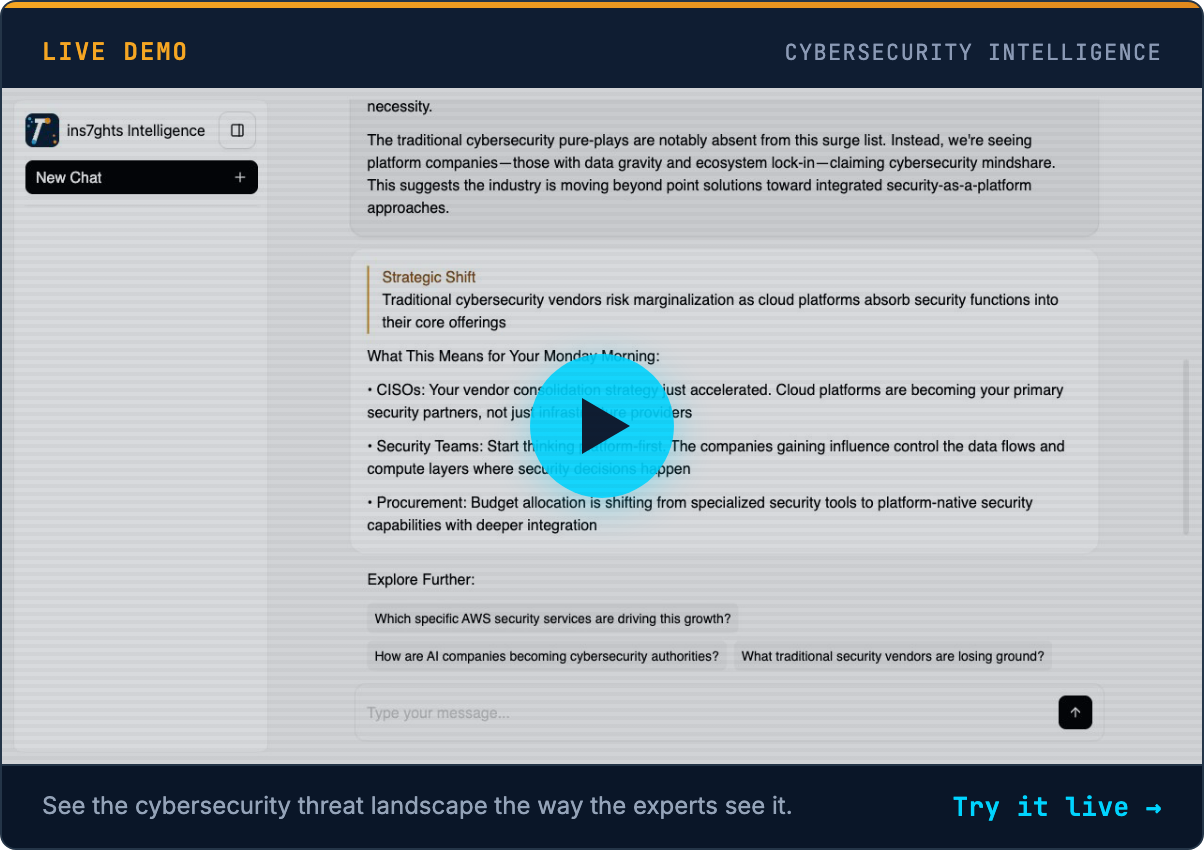
1,300+ articles scanned. 7 stories selected. Our AI distills the noise into signal—in seconds. Get early access →
Know someone who'd find this useful? Share your unique referral link →
Want Your Own AI Intelligence Briefing?
Our platform analyzes 1,000+ sources daily and delivers personalized insights in seconds.
Join the Waitlist →Founding members: Lifetime discount • Priority access • Shape the product